学习目标:
- 理解 MyBatis 的设计思想,说明它与 JDBC 的关系
- 熟悉 MyBatis 的输入映射,包括未使用注解、使用注解以及
${}与#{}的区别- 熟悉 MyBatis 的输出映射,理解
resultType与resultMap的联系和区别- 掌握动态 SQL 的常见写法,包括条件插入、条件更新、条件查询、
foreach和主键回填- 掌握一对一、一对多场景的结果封装,至少吃透一种实现方式
- 了解懒加载与缓存的基本思路
0. 课前准备
0.1 前置知识
- 会写常见 SQL 语句,尤其是 CRUD
- 能用 JDBC 完成 SQL 预编译、参数传递和结果集封装
- 了解懒加载与立即加载的基本概念
0.2 建议学习顺序
主线建议:
- MyBatis 介绍
- 入门案例(Quick Start)
- 基本 CRUD 与动态代理
- 输入映射
- 输出映射
- 多表查询
- 动态 SQL
补充与选学:
- 核心配置
- 注解开发
- 开发插件
- 懒加载
- 缓存
1. MyBatis介绍
SSM: Spring、Spring MVC、MyBatis
MyBatis本是Apache基金会的一个开源项目iBatis,2010年这个项目由Apache迁移到Google Code,并且改名为MyBatis。2013年11月代码迁移到了GitHub。MyBatis是一个基于Java的持久层框架。
更准确地说,MyBatis是一个持久层框架 / SQL 映射框架。它和ORM有关,但不是像Hibernate那样的“全自动ORM”。
- 类和表之间的关系(比如User类和cskaoyan_user表)
- 类中的成员变量和表中的列(名称、JavaType和JdbcType)
- 数据库中一条记录和Java中的一个实例(比如一个user对象和cskaoyan_user表中的一条记录)
MyBatis 是一款优秀的持久层框架,它支持自定义 SQL、
存储过程以及高级映射。MyBatis 免除了几乎所有的 JDBC 代码以及设置参数和获取结果集的工作。MyBatis 可以通过简单的 XML 或注解来配置和映射原始类型、接口和 Java POJO(Plain Old Java Objects,普通老式 Java 对象)为数据库中的记录。Java// ORM:Object Relationship Mapping。 对象关系映射(说白了, 就是可以把Java中的对象映射成关系)。 其实Mybatis就是一个可以帮助我们把 关系型数据库中的记录转化为 Java对象,把Java对象转化为关系型数据库中的记录的这么一个框架。Mybatis就是一个可以帮助我们在Java代码中更加高效的去操作数据库的这么一个框架。
2. 入门案例(Quick Start)
2.1 JDBC 方式回顾
//定义了UserDao接口,我们传入id,可以查询user的记录出来
public interface UserDao {
    User selectByPrimaryKey(Integer id) throws Exception;
    int insert(User user);
}
// 假如我们定义了实现类,那么我们可以这样子来调用获得user记录
public class JdbcExecution {
    // 查询id为2的用户
    public static void main(String[] args) throws Exception{
        UserDao userDao = new UserDaoImpl();
        User user = userDao.selectByPrimaryKey(2);
        System.out.println("user = " + user);
    }
}
接着问题就是我们在实现类中的代码,使用JDBC的方式来完成,我们也把过程中的一些操作做一些分析,可以参考注释
public class UserDaoImpl implements UserDao{
    @Override
    public User selectByPrimaryKey(Integer id) throws Exception {
        // 1.获得连接,如果后面需要提交事务,则执行connection.commit
        Connection connection = JdbcUtil.getConnection();
        // 2.预编译,预编译过程中传入了SQL语句
        PreparedStatement preparedStatement = connection.prepareStatement("select id, username, password, age, birthday, create_date, mobile from cskaoyan_user where id = ?");
        // 3.提供占位符位置的值
        preparedStatement.setInt(1,id);
        // 4.执行查询获得结果集
        ResultSet resultSet = preparedStatement.executeQuery();
        // 5.创建一个接收结果集中的值的实例
        User user = new User();
        while (resultSet.next()) {
            // 6.获得结果集中的username列(column)中的值
            String username = resultSet.getString("username");
            //   获得结果集中的password列(column)中的值
            String password = resultSet.getString("password");
            int age = resultSet.getInt("age");
            Date birthday = resultSet.getDate("birthday");
            Date createDate = resultSet.getDate("create_date");
            String mobile = resultSet.getString("mobile");
            user.setId(id);
            // 7.通过set方法封装给user实例中的username这个成员变量(property)
            user.setUsername(username);
            //   通过set方法封装给user实例中的password这个成员变量(property)
            user.setPassword(password);
            user.setAge(age);
            user.setBirthday(birthday);
            user.setCreateDate(createDate);
            user.setMobile(mobile);
        }
        return user;
    }
}
这个过程比较繁琐,并且存在着很多定制化的内容和耦合
- SQL语句和代码直接耦合在一起
- 设置参数过程比较繁琐,对应的关系只有占位符的序号,如果有多个占位符?的话,容易出错
- 查询结果集的使用比较繁琐
- 手动调用构造方法来获得实例
- 要关注列名从结果集中取出数据
- 要关注列的类型手动调用不同的方法,比如getInt、getString、getDate
- 取出的值需要使用set方法来封装
2.2 MyBatis 方式入门
MyBaits是这样的一样技术,将SQL语句集中管理起来了,使用的时候进行指定,并且完成自动传值和封装
导包
xml<!--mybatis--> <dependency> <groupId>org.mybatis</groupId> <artifactId>mybatis</artifactId> <version>3.5.9</version> </dependency> <!-- 数据库驱动包 --> <dependency> <groupId>mysql</groupId> <artifactId>mysql-connector-java</artifactId> <version>8.0.20</version> </dependency>配置1: 配置一个Mybatis的主配置文件,用来获取SqlSessionFactory
java// SqlSessionFactory:每一个Mybatis应用都是以SqlSessionFactory的实例对象为核心的。使用Mybatis必须以SqlSessionFactory的实例为核心,再以SqlSessionFactory的实例生产SqlSession实例对象的。 // SqlSession:这个其实表示和数据库之间的一个连接,里面封装了 Connection对象xml<?xml version="1.0" encoding="UTF-8" ?> <!DOCTYPE configuration PUBLIC "-//mybatis.org//DTD Config 3.0//EN" "http://mybatis.org/dtd/mybatis-3-config.dtd"> <configuration> <properties resource="jdbc.properties"/> <!--日志的配置--> <settings> <setting name="logImpl" value="STDOUT_LOGGING"/> </settings> <environments default="development"> <environment id="development"> <transactionManager type="JDBC"/> <dataSource type="POOLED"> <property name="driver" value="com.mysql.cj.jdbc.Driver"/> <property name="url" value="${url}"/> <property name="username" value="${username}"/> <property name="password" value="${password}"/> </dataSource> </environment> </environments> <mappers> <mapper resource="com/cskaoyan/mapper/UserMapper.xml"/> </mappers> </configuration>配置2: 配置一个专门用来存放SQL语句的配置文件,Mapper.xml
Java// 在Mybatis中,这样的文件可以有多个 // 这些文件,都必须在Mybatis的主配置文件中,声明进来、xml<?xml version="1.0" encoding="UTF-8" ?> <!DOCTYPE mapper PUBLIC "-//mybatis.org//DTD Mapper 3.0//EN" "http://mybatis.org/dtd/mybatis-3-mapper.dtd"> <!-- namespace: 命名空间,整个项目中必须唯一,暂时可以任意取名(后面再进行标准化) --> <mapper namespace="usersql"> <!-- 每个标签都需要一个唯一的id属性: 每一个标签的id不能重复(本Mapper文件中), 用来标识一条SQL --> <!-- 在这个Mapper文件中, 怎么唯一表示SQL语句? namespace.id (命名空间.标签的id ) 是这个SQL语句的坐标 --> <!-- <insert> 插入标签 --> <!-- <delete> 删除标签 --> <!-- <update> 修改标签 --> <!-- <select> 查询标签 --> <!-- parameterType:参数的类型(可以省略,标准语法要指明 ) --> <!-- resultType:返回的结果集的类型(不能省略) --> <select id="selectByPrimaryKey" resultType="com.cskaoyan.model.User"> select id, username, password, age, birthday, create_date as createDate, mobile from cskaoyan_user where id = #{id} </select> </mapper>使用
Java//使用的代码和前面完全一样 public class MyBatisExecution { // 查询id为2的用户 public static void main(String[] args) throws Exception{ UserDao userDao = new UserDaoImpl(); User user = userDao.selectByPrimaryKey(2); System.out.println("user = " + user); } }但是UserDaoImpl中的实现则完全不一样了
javapublic class UserDaoImpl implements UserDao{ @Override public User selectByPrimaryKey(Integer id) { // 1.获得全局共享的SqlSessionFactory(线程安全) SqlSessionFactory sqlSessionFactory = MyBatisUtil.getSqlSessionFactory(); // 2.开启SqlSession(线程不安全),其中封装了Connection try (SqlSession sqlSession = sqlSessionFactory.openSession()) { // 3.(1)传入Sql的坐标;(2)传入参数;(3)查询结果集的封装 User user = sqlSession.selectOne("usersql.selectByPrimaryKey", id); return user; } } }其中MyBatisUtil是提供全局共享的SqlSessionFactory实例的
javapublic class MyBatisUtil { // 线程安全的值,可以全局共享 private static SqlSessionFactory sqlSessionFactory; static { try { sqlSessionFactory = new SqlSessionFactoryBuilder().build(Resources.getResourceAsStream("mybatis.xml")); } catch (IOException e) { e.printStackTrace(); } } public static SqlSessionFactory getSqlSessionFactory() { return sqlSessionFactory; } }
2.3 Quick Start 小结
在上面的案例中MyBatis默默的替我们做了什么事情
- connection.preparedStatement需要传入的Sql语句,我们仅仅提供了坐标(映射文件的命名空间+id)
- 参数和占位符的对应关系,自动对应起来
- resultSet获得结果集,并且封装为User实例的过程完全是MyBatis自动完成的
而上面的过程其实是实际开发过程中非常繁琐,而又很通用的事情
- JDBC 的问题不是不能用,而是样板代码太多。
- MyBatis 没有替你写 SQL,但替你做了参数绑定和结果封装。
- 核心价值就是“SQL 与 Java 解耦 + 减少重复代码”。
3. 基本 CRUD
3.1 动态代理
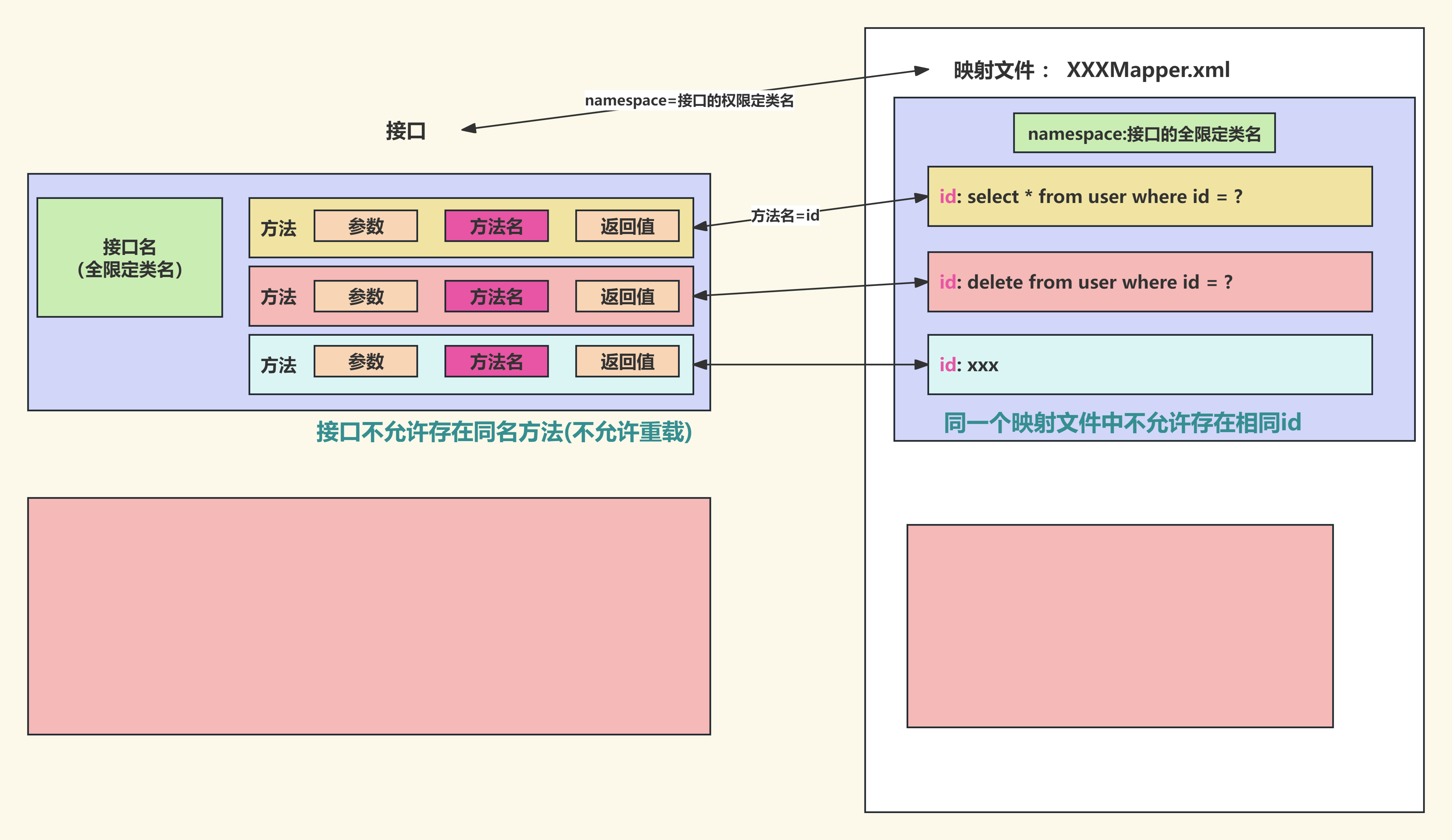
Mybatis的动态代理可以帮助我们去生成接口的代理对象。我们可以自己不实现接口。
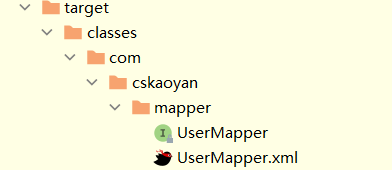
java// 不需要实现接口,那么就需要遵守Mybatis使用动态代理的一些规则 1, 接口的全限定名称 和 mapper.xml中的namespace的值保持一致 2, 接口中的方法和 xml文件中的 <select> <insert> <update> <delete> 标签 一一对应,并且方法名要和标签的id值保持一致 3, 方法的返回值类型和标签中的resultType保持一致(注意:添加/删除/修改不需要返回值类型) 4, 参数保持一致(暂时可以不写) // 建议要遵守的规则:希望 1, 文件的名字 UserMapper.xml | UserMapper.java 建议保持一致 2, UserMapper.xml 和UserMapper.java 在编译之后的位置应该要在同一个路径下
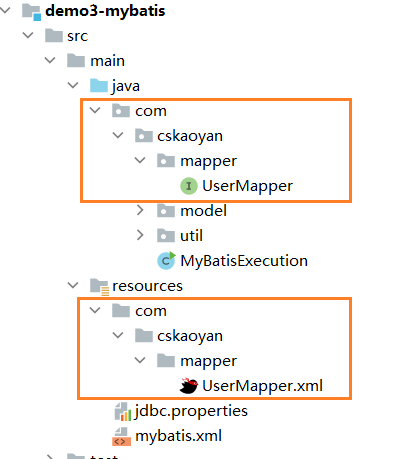
编译后在同一路径
如何使用动态代理呢?
Javapublic class MyBatisExecution { // 查询id为2的用户 public static void main(String[] args) throws Exception{ //UserDao userDao = new UserDaoImpl(); // 1.获取SqlSession try (SqlSession sqlSession = MyBatisUtil.getSqlSessionFactory().openSession()) { // 2.根据SqlSession获得Mapper代理对象 UserMapper userDao = sqlSession.getMapper(UserMapper.class); // 3.代理对象执行方法 User user = userDao.selectByPrimaryKey(2); System.out.println("user = " + user); } } }思考:代理对象做增强,他做了什么增强?
3.2 增删改查示例
添加
JavaAccount account = new Account(); account.setId(10); account.setName("李白"); account.setMoney(200); int rows = accountMapper.insertAccount(account); // sqlSession.commit(); Connection connection = sqlSession.getConnection(); connection.commit();java// 添加 public int insertAccount(Account account);xml<!--public int insertAccount(Account account);--> <insert id="insertAccount" > insert into account set id=#{id}, name=#{name}, money=#{money} </insert>删除
`Javaint rows = accountMapper.deleteAccountById(10); // sqlSession.commit(); Connection connection = sqlSession.getConnection(); connection.commit();java// 删除 public int deleteAccountById(Integer id);xml<delete id="deleteAccountById"> delete from account where id=#{id} </delete>修改
javaAccount account = new Account(); account.setId(10); account.setName("zs"); account.setMoney(2000); int rows = accountMapper.updateAccountById(account); // sqlSession.commit(); Connection connection = sqlSession.getConnection(); connection.commit();Java// 修改 public int updateAccountById(Account account);xml<update id="updateAccountById"> update account set name=#{name}, money=#{money} where id =#{id} </update>查找
javaAccount account = accountMapper.selectAccountById(10); System.out.println(account);java// 查找 public Account selectAccountById(Integer id);xml<select id="selectAccountById" resultType="com.cskaoyan.bean.Account"> select * from account where id = #{id} </select>
3.3 事务
在使用Mybatis的时候, 自带事务,而且事务默认情况下是不会自动提交的
Java// 解决办法一: 执行完SQL语句之后, 使用sqlSession提交事务 sqlSession.commit(); // 解决办法二: 执行完SQL语句之后, 使用sqlSession内部封装的Connection 提交事务 Connection conn = sqlSession.getConnection(); conn.commit(); // 解决办法三:(自动提交) 在获得SqlSession的时候, 给sqlSessionFactory.openSession设置为真 // 获取到的SqlSession,里面的connection不会自动提交 SqlSession session = sqlSessionFactory.openSession(); // 获取自动提交的SqlSession SqlSession session = sqlSessionFactory.openSession(true);
4. 输入映射
输入映射其实就是在说Mybatis是如何传值的。
映射文件中的SQL语句中的语法 --> #{}里写什么东西
4.1 #{} 在预编译阶段会变成什么
在Mapper接口中 方法的形参写了什么样式(个数、类型、注解),最终在映射文件中该方法对应的sql语句中的#{}应该如何写
java// 只有一个参数 // 传递多个参数 // ....
4.2 一个参数
一个参数: (基本类型、包装类、String)
1, #{任意值} 来取值: 不建议使用(显得不标准), 建议使用注解写法
java// 虽然一个参数的时候, 可以在{}内部任意书写参数名, 这种乱写行为不好, 不要这么写java// 查找 public Account selectAccountById(Integer id);xml<select id="selectAccountById" resultType="account"> select * from account where id = #{xxx} </select>2, 如果在方法中 的一个参数 加了@Param注解,那么 后面就只能通过 #{注解值} 来取值
java// 查找 public Account selectAccountById2(@Param("id") Integer id);xml<select id="selectAccountById2" resultType="acc"> select * from account where id = #{id} </select>
4.3 多个参数
多个参数: 需要注解指明#{注解值} 来取值
java// 1, 直接写多个值, 用参数名简单匹配是不识别的 // 2, 如果参数名简单匹配是不识别, 又不想加注解, 也是有别的解决手段(按位传值: 不建议), 但是建议加注解(最标准的写法)java// 查找 List<Account> selectListByIdOrName(@Param("id") Integer id, @Param("name") String name);xml<select id="selectListByIdOrName" resultType="acc"> select * from account where id = #{id} or name = #{name} </select>
4.4 对象传值
对象传值
方式一: SQL使用的参数命名要和对象内部属性保持一致 (#{成员变量名} 来取值)
javapublic interface UserMapper { //对象传值 → 没有使用@Param注解 → 成员变量名 int insert1(User user); }xml<insert id="insert1"> insert into cskaoyan_user (username, password, age, birthday, create_date, mobile) values (#{username},#{password},#{age},#{birthday},#{createDate},#{mobile}) </insert>方式二: 对象有注解, 必须通过 #{注解值 . 成员变量名} 来取值
java//对象传值 → 使用@Param注解 → @Param写了什么就用什么 → user.username、user.password等 int insert2(@Param("user") User user);xml<insert id="insert2"> insert into cskaoyan_user (username, password, age, birthday, create_date, mobile) values (#{user.username},#{user.password},#{user.age},#{user.birthday},#{user.createDate},#{user.mobile}) </insert>
注意: 对象和多参数混合问题
4.5 使用 Map 传值
Map传值: 不建议使用
方式一: SQL使用的参数命名要和Map中存储数据的key保持一致 (#{key} 来取值)
java//Map传值 → 没有使用@Param注解 → #{}里写的是map的key:id和username int updateUsernameById(Map map);xml<update id="updateUsernameById"> update cskaoyan_user set username = #{username} where id = #{id} </update>方式二: Map对象有注解, 必须通过 #{注解值 . key} 来取值
java//Map传值 → 使用@Param注解 → #{}里写的是@Param注解的值 + map的key:map.id和map.username int updateUsernameById2(@Param("map") Map map);xml<update id="updateUsernameById2"> update cskaoyan_user set username = #{map.username} where id = #{map.id} </update>
4.6 按位置传值
按位传值: 完全不建议(容易因为程序员的记忆和修改导致bug产生, 除非除了按位传值没办法了)
方式一: arg0、arg1、arg2...
javauserMapper.insertUser("zs", 18, "湖北");xml<insert id="insertUser"> insert into `user` set `name`=#{arg0}, age=#{arg1}, address=#{arg2} </insert>方式二: param1、param2、param3...
javauserMapper.insertUser("zs", 18, "湖北");xml<insert id="insertUser"> insert into `user` set `name`=#{param1}, age=#{param2}, address=#{param3} </insert>在Mybatis的输入映射中,我们经常使用前面三种方式(传入一个参数、传入多个参数、传递对象),后面通过map传值和按照位置来传值 一般不使用,也不建议大家使用。
4.7 #{} 与 ${} 的区别
\${}做的就是字符串的拼接,如果你传入的是字符串,需要你手动在\${}外围手动增加单引号 ''
核心点: 使用${}有sql注入的风险
SQL注入:在你执行的SQL语句之外额外执行一部分,导致信息泄露或数据库被丢弃;
使用#{}过程是预编译,不会有SQL注入的风险,建议大家使用的方式
\#{参数}使用: 预编译占位 (尽量使用 #{} ) PreparedStatement
javauserMapper.insertUserC("zs", 18, "湖北");xml<insert id="insertUserC"> insert into `user` set `name`=#{param1}, age=#{param2}, address=#{param3} </insert>
${参数}使用: 字符串拼接, Statement (存在SQL注入问题)
javauserMapper.insertUserP("zs", 18, "湖北");xml<insert id="insertUserP"> insert into `user` set `name`= '${param1}', age=${param2}, address='${param3}' </insert>
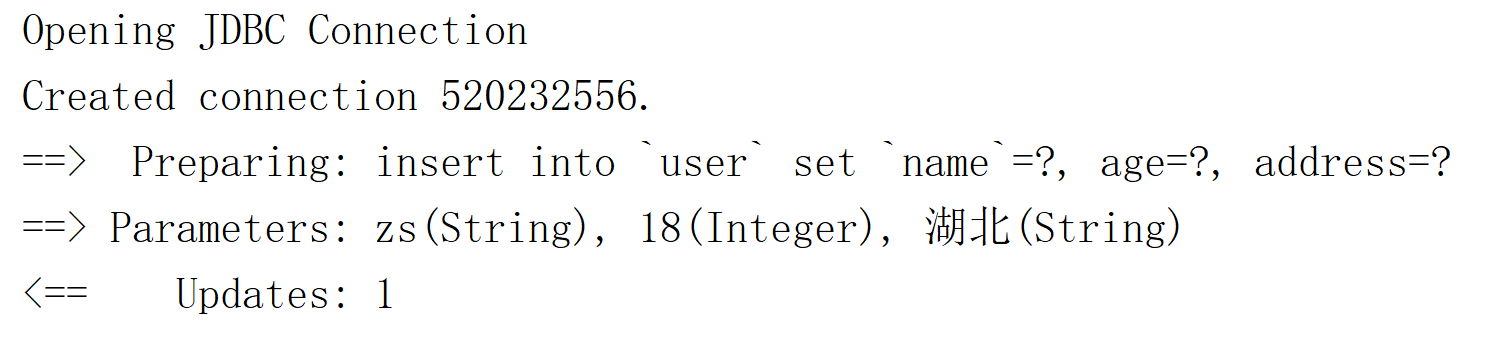
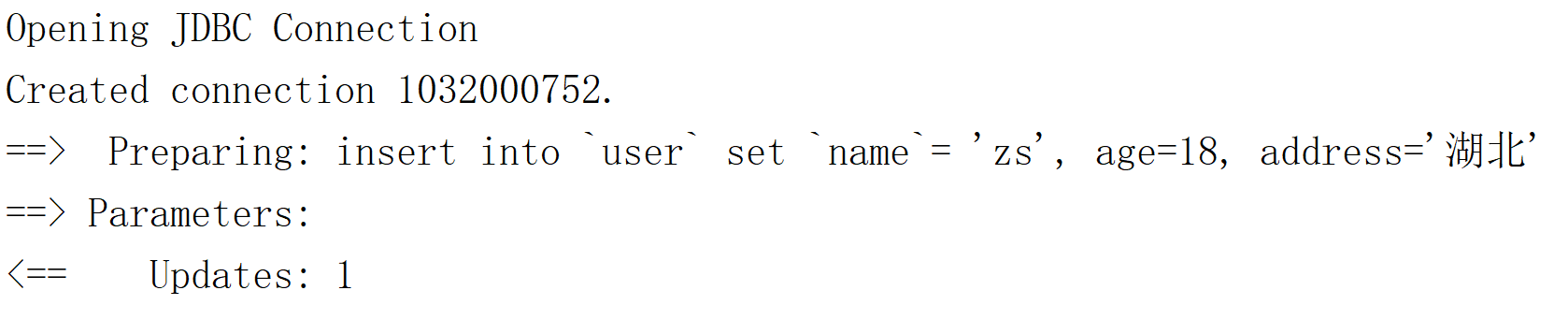
SELECT id,product,money FROM `cskaoyan_product` where id = 3;
-- 如果我们使用#{}的方式
-- Preparing:
SELECT id,product,money FROM `cskaoyan_product` where id = ?
-- Parameters:3
-- 如果我们使用${}的方式
-- id提供的值是3
-- Preparing:
SELECT id,product,money FROM `cskaoyan_product` where id = '3';
-- Parameters:
-- 如果有不法分子,提供的参数不是3,在3的基础上额外搞了一些东西
-- 3' or '1' = '1
SELECT id,product,money FROM `cskaoyan_product` where id = '3' or '1' = '1';4.7.1 注意
`java//1, 我们以后开发的时候,应该尽量使用 #{} 去接收传递过来的参数值 //2, 当我们传递给SQL语句 表名或者是列名的时候,就必须得使用 ${} 来取值。分表问题: 动态表名
java// userMapper.dynamicTableName("user2"); userMapper.dynamicTableName("user");javaList<User> dynamicTableNameList(String user);xml<select id="dynamicTableNameList" resultType="com.snow.www.bean.User"> select * from ${user} </select>分列问题: 动态列名
java// List<User> list = userMapper.dynamicColumnName("id"); List<User> list = userMapper.dynamicColumnName("age");javaList<User> dynamicColumnName(String age);xml<select id="dynamicColumnName" resultType="com.snow.www.bean.User"> select * from user order by ${column} </select>
分表的思考.
4.8 思考
MyBatis在输入映射过程中有传入对象作为参数,那么这个过程是对JDBC做封装,思考一个问题就是JDBC过程会如何使用我们的对象的
比如这个接口和方法
public interface UserMapper {
 //对象传值 → 没有使用@Param注解 → 成员变量名
 int insert1(User user);

}对JDBC过程在分解一下
Connection connection = ConnectionUtil.getConnection();
PreparedStatement preparedStatement = connection.preparedStatement("insert into cskaoyan_user (username, password, age, birthday, create_date, mobile) values (?,?,?,?,?,?)");
// 传入的是user对象
preparedStatement.setString(1,user.getUsername());
preparedStatement.setString(2,user.getPassword());
...
输入映射,MyBatis如何使用的user,通过get方法来使用的
5. 输出映射
一定和查询有关系 → 一定对应的是select标签
使用select标签一定会使用和类型有关系的属性:resultType、resultMap
resultType中可以写别名
resultType写的是单条记录的类型
-- 只有1列,并且记录数为1条  → 查询user表中有多少条记录
-- 一个int或Integer类型的值来接收
select count(*) from cskaoyan_user ;

-- 只有一列,结果的记录数为多条 → 查询年龄为xxx的用户的名称
-- 数组或List、Set
select username from cskaoyan_user where age = 25;

-- 多列,结果的记录数为1条 → 查询id为某个值的用户的全部信息
-- 引用类型对象
select id,username,password,age,birthday,create_date,mobile from cskaoyan_user where id = 2;

-- 多列,结果的记录数为多条 → 查询年龄为xxx的用户的全部信息
-- 引用类型对象的数组或List、Set
select id,username,password,age,birthday,create_date,mobile from cskaoyan_user where age = 25;
选择何种封装类型:取决于结果集中的列的个数,以及结果的记录数
封装最终体现在哪里?落脚点在Mapper接口中的方法的返回值类型
输出映射是指Mybatis是如何把SQL语句执行结果映射为 Java对象的。
java// 一个参数 // 多个参数 // 单个对象 // 多个对象 // resultMap: 比较重要(很常用)
5.1 一个结果
结果列为1且记录数为1(或0)
一个参数: 必须要有resultType(写简单参数的
全限定名称或者是内置的别名)java// 单个列,结果记录数为1 int selectCount(); String selectNameById(@Param("id") Integer id);//List<String> list → list.get(0)xml<select id="selectCount" resultType="int"> select count(*) from cskaoyan_user </select> <select id="selectNameById" resultType="java.lang.String"> select username from cskaoyan_user where id = #{id} </select>
5.2 多个结果
列只有一列,结果集中的记录数有多条(0或1条)
指: 多个参数构成的数组/List/Set
java// 当我们返回多个简单参数的时候,在方法中定义的是数组就会返回数组,定义的是集合就会返回集合。xml中的标签配置不需要改变。并且, resultType的值是单个元素的类型。java// 单个列,结果记录数为多条 // 按照不同的类型来封装,但是SQL语句是一样的 String[] selectNamesByAge1(@Param("age") Integer age); List<String> selectNamesByAge2(@Param("age") Integer age); Set<String> selectNamesByAge3(@Param("age") Integer age);`xml<select id="selectNamesByAge1" resultType="java.lang.String"> select username from cskaoyan_user where age = #{age} </select> <select id="selectNamesByAge2" resultType="java.lang.String"> select username from cskaoyan_user where age = #{age} </select> <select id="selectNamesByAge3" resultType="java.lang.String"> select username from cskaoyan_user where age = #{age} </select>
5.3 单个对象
核心点:查询结果集中的列名 要和 对象中的成员变量名(set方法)相同
查询结果集中的列名可以通过as起别名的方式做修改
单个对象:
java// 1. Mybatis在去映射的时候,会把`成员变量名` 和`查询结果的列名`去一一映射,假如原始表中的列名和成员变量名不一致的话,我们可以通过取别名的方式来解决(也可以通过resultMap来解决) // 2. 在声明JavaBean的成员变量的时候,尽量的使用包装类型java// 多个列,结果记录数为1 User selectByPrimaryKey(@Param("id") Integer id);`xml<select id="selectByPrimaryKey" resultType="com.cskaoyan.demo2.bean.User"> select id, username, password, age, birthday, create_date as createDate, mobile from cskaoyan_user where id = #{id} </select>
5.4 多个对象
如果是采用JDBC会如何写
ResultSet resultSet = prepareStatement.executeQuery();
List<User> users = new ArrayList<>();
while(resultSet.next()){
  User user = new User();
  user.setUsername(resultSet.getString("username"));
  user.setPassword(resultSet.getString("password"));
  user.setAge(resultSet.getInt("age"));
  user.setBirthday(resultSet.getDate("birthday"));
  user.setCreateDate(resultSet.getDate("createDate"));
  user.setMobile(resultSet.getString("mobile"));
  users.add(user);
}
//如果你需要一个Set可以在第2行这里定义为一个set ,也可以将这个List转为一个Set
//如果你需要一个数组,也可以将这个List转为一个数组
多个对象: 数组/List/Set
java//1, resultType的值是单个元素的类型。`java// 多个列,结果记录数为多条 User[] selectByAge1(@Param("age") Integer age); List<User> selectByAge2(@Param("age") Integer age); Set<User> selectByAge3(@Param("age") Integer age);xml<select id="selectByAge1" resultType="com.cskaoyan.demo2.bean.User"> select id, username, password, age, birthday, create_date as createDate, mobile from cskaoyan_user where age = #{age} </select> <select id="selectByAge2" resultType="com.cskaoyan.demo2.bean.User"> select id, username, password, age, birthday, create_date as createDate, mobile from cskaoyan_user where age = #{age} </select> <select id="selectByAge3" resultType="com.cskaoyan.demo2.bean.User"> select id, username, password, age, birthday, create_date as createDate, mobile from cskaoyan_user where age = #{age} </select>
5.5 resultMap
核心点:查询结果集中的列名 要和 对象中的成员变量名(set方法)对应
存在这样的对应关系,我们才知道从结果集拿那一列的值(resultSet.getString("列名")),获得的值要封装给哪一个成员变量
resultMap: 是用来做结果映射的
java@Data public class UserVo { private Integer userId; private String userName; private Integer userAge; private String userMobile; }javaUserVo selectUserVoByPrimaryKey(@Param("id") Integer id);xml<!--id属性:要和select标签中的resultMap属性建立联系--> <!--type属性:写的是要封装的对象的全限定类名(或别名)--> <resultMap id="userVoMap" type="com.cskaoyan.demo2.bean.UserVo"> <!--查询结果集中的列名要和成员变量名建立映射关系--> <id column="id" property="userId"/> <result column="age" property="userAge"/> <result column="username" property="userName"/> <result column="mobile" property="userMobile"/> </resultMap> <!--resultMap属性中写的是引用的resultMap标签的id--> <select id="selectUserVoByPrimaryKey" resultMap="userVoMap"> select id,username,age,mobile from cskaoyan_user where id = #{id} </select>
resultMap是可以复用的
6. 多表查询
6.1 一对一结构
结构示例
sqlCREATE TABLE `cskaoyan_user` ( `id` int(11) NOT NULL AUTO_INCREMENT, `username` varchar(255) DEFAULT NULL, `password` varchar(255) DEFAULT NULL, `age` int(11) DEFAULT NULL, `birthday` datetime DEFAULT NULL, `create_date` datetime DEFAULT NULL, `mobile` varchar(255) DEFAULT NULL, PRIMARY KEY (`id`) ) ENGINE=InnoDB AUTO_INCREMENT=69 DEFAULT CHARSET=utf8mb4; CREATE TABLE `cskaoyan_user_detail` ( `id` int(11) NOT NULL AUTO_INCREMENT, `phone` varchar(255) DEFAULT NULL, `email` varchar(255) DEFAULT NULL, `user_id` int(11) DEFAULT NULL, PRIMARY KEY (`id`) ) ENGINE=InnoDB AUTO_INCREMENT=3 DEFAULT CHARSET=utf8mb4;java@Data @AllArgsConstructor @NoArgsConstructor public class User { private Integer id; private String username; private String password; private Integer age; private Date birthday; private Date createDate; private String mobile; private UserDetail userDetail; } @Data public class UserDetail { Integer id; String phone; String email; String userId; }
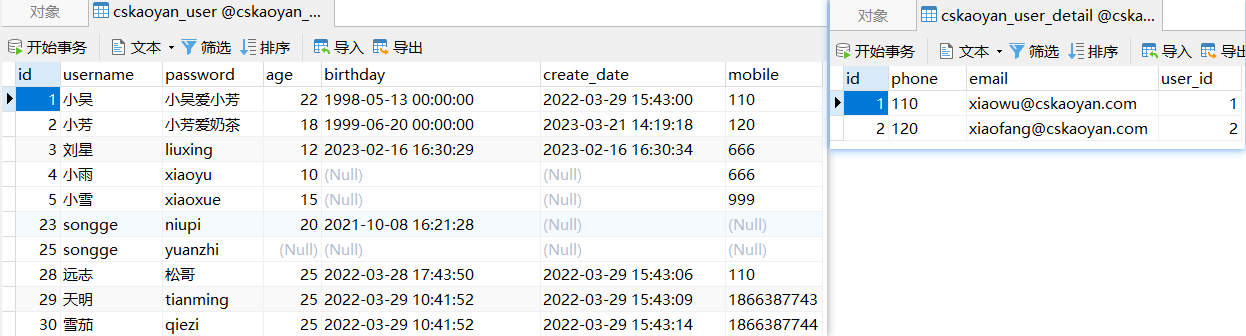
方式一:分次查询
UserMapper接口
java//查询到user的信息,并且也能查询到userDetail的信息 User selectUserByUsername(@Param("username") String username); User[] selectUsersInIdArray(@Param("ids") Integer[] ids);UserMapper.xml文件和UserDetailMapper.xml文件
xml<mapper namespace="com.cskaoyan.demo2.mapper.UserMapper"> <resultMap id="userMap" type="com.cskaoyan.vo.User"> <result column="id" property="id"/> <result column="username" property="username"/> <result column="password" property="password"/> <result column="age" property="age"/> <result column="birthday" property="birthday"/> <result column="mobile" property="mobile"/> <!--column属性:始终对应的是查询结果的列名--> <!--property属性:始终对应的是父标签类型的成员变量名--> <result column="create_date" property="createDate"/> <!--新的标签association → 一对一关系--> <!--column属性:始终对应的是查询结果的列名,对应的是第一次查询的查询结果的列名,并且也作为第二次查询的参数--> <!--property属性:始终对应的是父标签类型的成员变量名--> <!--select属性:执行的第二个sql是谁 → 第二次查询的命名空间+id → 采用的参数是第一次查询结果的column属性列对应的结果--> <association column="id" property="userDetail" select="com.cskaoyan.mapper.UserMapper.selectUserDetailByUserId"/> </resultMap> <select id="selectUserByUsername" resultMap="userMap"> SELECT id, username, password, age, mobile, birthday, create_date from cskaoyan_user where username = #{username} </select> <select id="selectUserDetailByUserId" resultType="com.cskaoyan.vo.UserDetail"> select id, phone, email from cskaoyan_user_detail where user_id = #{id} </select> <select id="selectUsersInIdArray" resultMap="userMap"> SELECT id,username,password,age,mobile,birthday,create_date from cskaoyan_user where id in <foreach collection="ids" item="id" separator="," open="(" close=")"> #{id} </foreach> </select> </mapper> <mapper namespace="com.cskaoyan.demo2.mapper.UserDetailMapper"> <select id="selectByUserId" resultType="com.cskaoyan.demo2.bean.UserDetail"> select id, phone, email, user_id as userId from cskaoyan_user_detail where user_id = #{userId} </select> </mapper>
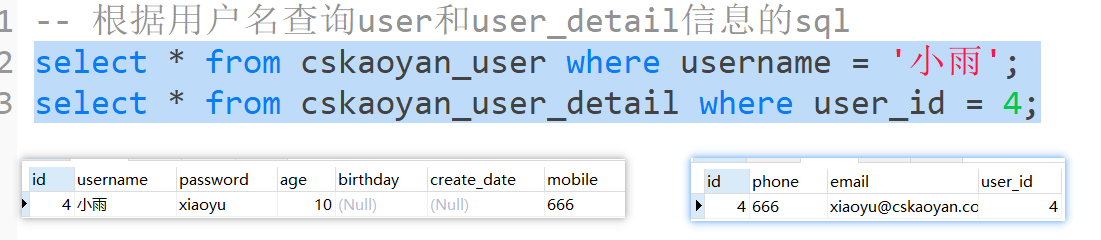
方式二:连接查询
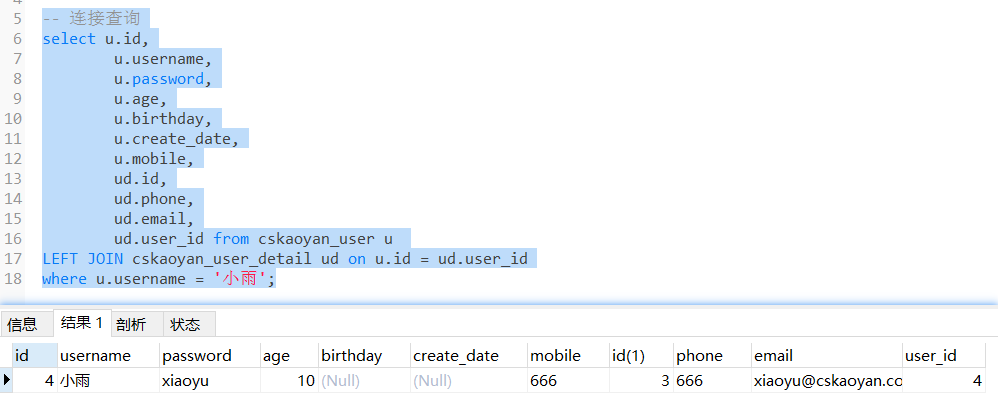
UserMapper接口
java// 通过左连接查询的方式来查询、封装 User selectUserByUsernameLeftJoin(@Param("username") String username);UserMapper.xml
xml<resultMap id="userMap2" type="com.cskaoyan.demo2.bean.User"> <id column="id" property="id"/> <result column="username" property="username"/> <result column="password" property="password"/> <result column="age" property="age"/> <result column="birthday" property="birthday"/> <result column="create_date" property="createDate"/> <result column="mobile" property="mobile"/> <!--进一步建立映射关系--> <association property="userDetail" javaType="com.cskaoyan.demo2.bean.UserDetail"> <id column="udid" property="id"/> <result column="phone" property="phone"/> <result column="email" property="email"/> <result column="user_id" property="userId"/> </association> </resultMap> <select id="selectUserByUsernameLeftJoin" resultMap="userMap2"> select u.id, u.username, u.password, u.age, u.birthday, u.create_date, u.mobile, ud.id as udid, ud.phone, ud.email, ud.user_id from cskaoyan_user u LEFT JOIN cskaoyan_user_detail ud on u.id = ud.user_id where u.username = #{username} </select>
6.2 一对多结构
结构示例
sqlCREATE TABLE `cskaoyan_order` ( `id` int(11) NOT NULL AUTO_INCREMENT, `name` varchar(255) DEFAULT NULL, `price` decimal(10,2) DEFAULT NULL, `user_id` int(11) DEFAULT NULL, PRIMARY KEY (`id`) ) ENGINE=InnoDB AUTO_INCREMENT=6 DEFAULT CHARSET=utf8mb4;java@Data @AllArgsConstructor @NoArgsConstructor public class Order { private Integer id; private String name; private Double price; } @Data @AllArgsConstructor @NoArgsConstructor public class User { private Integer id; private String username; private String password; private Integer age; private Date birthday; private Date createDate; private String mobile; private UserDetail userDetail; private List<Order> orders; }

方式一:分次查询
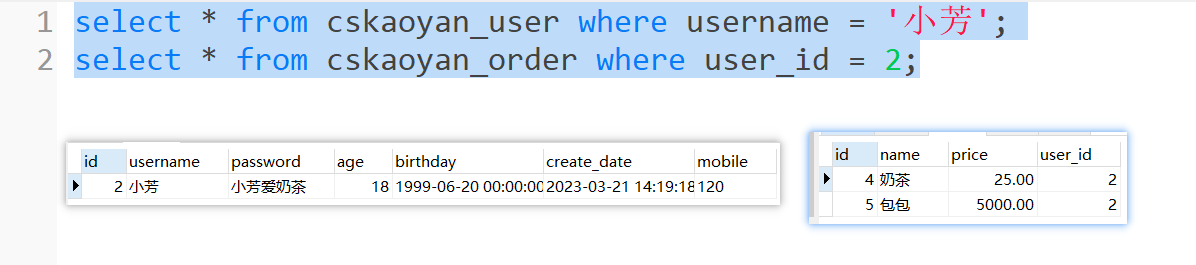
UserMapper接口
javaUser selectByPrimaryKey(@Param("id") Integer id); User selectByUsername(@Param("username") String username);UserMapper.xml
xml<mapper namespace="com.cskaoyan.demo3.mapper.UserMapper"> <sql id="Base_User_Select"> select id, username, password, age, birthday, create_date, mobile from cskaoyan_user </sql> <resultMap id="userMap" type="com.cskaoyan.demo3.bean.User"> <id column="id" property="id"/> <result column="username" property="username"/> <result column="password" property="password"/> <result column="age" property="age"/> <result column="birthday" property="birthday"/> <result column="create_date" property="createDate"/> <result column="mobile" property="mobile"/> <collection property="orders" column="id" select="com.cskaoyan.demo3.mapper.OrderMapper.selectByUserId"/> </resultMap> <select id="selectByPrimaryKey" resultMap="userMap"> <include refid="Base_User_Select"/> where id = #{id} </select> <select id="selectByUsername" resultMap="userMap"> <include refid="Base_User_Select"/> where username = #{username} </select> </mapper> <mapper namespace="com.cskaoyan.demo3.mapper.OrderMapper"> <resultMap id="orderMap" type="com.cskaoyan.demo3.bean.Order"> <id column="id" property="id"/> <result column="name" property="name"/> <result column="price" property="price"/> </resultMap> <select id="selectByUserId" resultMap="orderMap"> select id, name, price, user_id from cskaoyan_order where user_id = #{userId} </select> </mapper>
方式二:连接查询
UserMapper接口
javaUser[] selectUsersByIdArrayLeftJoin(@Param("ids") Integer[] ids);UserMapper.xml
xml<resultMap id="userMapLeftJoin" type="com.cskaoyan.vo.User"> <result column="id" property="id"/> <result column="username" property="username"/> <result column="password" property="password"/> <result column="age" property="age"/> <result column="birthday" property="birthday"/> <result column="mobile" property="mobile"/> <!--column属性:始终对应的是查询结果的列名--> <!--property属性:始终对应的是父标签类型的成员变量名--> <result column="create_date" property="createDate"/> <!--和一对一类型的表达不同--> <collection property="orders" ofType="com.cskaoyan.vo.Order"> <result column="oid" property="id"/> <result column="name" property="name"/> <result column="price" property="price"/> </collection> </resultMap> <select id="selectUsersByIdArrayLeftJoin" resultMap="userMapLeftJoin"> select u.id,u.username,u.password,u.age,u.mobile,u.birthday,u.create_date, o.id as oid, o.name, o.price from cskaoyan_user u left join cskaoyan_order o on u.id = o.user_id where u.id in <foreach collection="ids" item="id" separator="," open="(" close=")"> #{id} </foreach> </select>
6.3 多对多结构
结构示例
sqlCREATE TABLE `cskaoyan_relation` ( `id` int(11) NOT NULL AUTO_INCREMENT, `stu_id` int(11) DEFAULT NULL, `c_id` int(11) DEFAULT NULL, PRIMARY KEY (`id`) ) ENGINE=InnoDB AUTO_INCREMENT=7 DEFAULT CHARSET=utf8mb4; CREATE TABLE `cskaoyan_student` ( `id` int(11) NOT NULL AUTO_INCREMENT, `name` varchar(255) DEFAULT NULL, PRIMARY KEY (`id`) ) ENGINE=InnoDB AUTO_INCREMENT=4 DEFAULT CHARSET=utf8mb4; CREATE TABLE `cskaoyan_course` ( `id` int(11) NOT NULL AUTO_INCREMENT, `name` varchar(255) DEFAULT NULL, PRIMARY KEY (`id`) ) ENGINE=InnoDB AUTO_INCREMENT=4 DEFAULT CHARSET=utf8mb4;`java@Data public class Student { Integer id; String name; List<Course> courses; } @Data public class Course { Integer id; String name; List<Student> students; }
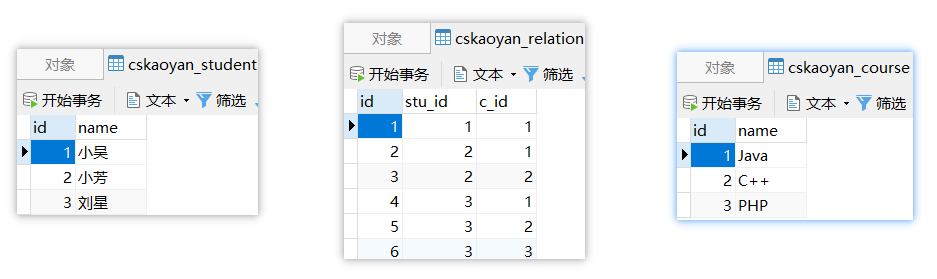
方式一:分次查询
Mapper接口
javapublic interface StudentMapper { Student selectByName(@Param("name") String name); }Mapper.xml
xml<mapper namespace="com.cskaoyan.mapper.StudentMapper"> <!--该映射文件里采用的是分次查询--> <resultMap id="studentMap" type="com.cskaoyan.vo.Student"> <result column="id" property="id"/> <result column="name" property="name"/> <collection property="courses" column="id" select="com.cskaoyan.mapper.StudentMapper.selectCoursesByStudentId"/> </resultMap> <select id="selectByName" resultMap="studentMap"> select id, name from cskaoyan_student where name = #{name} </select> <resultMap id="courseMap" type="com.cskaoyan.vo.Course"> <result column="id" property="id"/> <result column="name" property="name"/> </resultMap> <select id="selectCoursesByStudentId" resultMap="courseMap"> select c.id, c.name from cskaoyan_course c left join cskaoyan_relation r on c.id = r.c_id where r.stu_id = #{id} </select> </mapper>
方式二:连接查询
Mapper接口
javapublic interface CourseMapper { Course selectByName(@Param("name") String name); }Mapper.xml
xml<mapper namespace="com.cskaoyan.mapper.CourseMapper"> <resultMap id="courseMap" type="com.cskaoyan.vo.Course"> <result column="id" property="id"/> <result column="name" property="name"/> <collection property="students" ofType="com.cskaoyan.vo.Student"> <result column="sid" property="id"/> <result column="sname" property="name"/> </collection> </resultMap> <select id="selectByName" resultMap="courseMap"> select c.id, c.name, s.id as sid, s.name as sname from cskaoyan_course c LEFT JOIN cskaoyan_relation r ON c.id = r.c_id LEFT JOIN cskaoyan_student s ON s.id = r.stu_id where c.`name` = #{name} </select> </mapper>
7. 动态 SQL
动态SQL是Mybatis给我们提供的又一个强大的功能。可以帮助我们根据传入的条件,动态的去改变SQL语句。
通过在映射文件中使用一些不同的标签,会让一个方法对应的SQL语句(主要是insert、delete、update、select标签内的sql语句)产生变化
是为了让你这个标签内的SQL更强大,更通用
数据准备
sql/* Navicat Premium Data Transfer Source Server : stone61 Source Server Type : MySQL Source Server Version : 80300 Source Host : localhost:3306 Source Schema : clazz61 Target Server Type : MySQL Target Server Version : 80300 File Encoding : 65001 Date: 08/08/2024 20:32:54 */ SET NAMES utf8mb4; SET FOREIGN_KEY_CHECKS = 0; -- ---------------------------- -- Table structure for cskaoyan_phone -- ---------------------------- DROP TABLE IF EXISTS `cskaoyan_phone`; CREATE TABLE `cskaoyan_phone` ( `id` int NOT NULL AUTO_INCREMENT, `brand` varchar(50) CHARACTER SET utf8mb4 COLLATE utf8mb4_general_ci NOT NULL, `name` varchar(50) CHARACTER SET utf8mb4 COLLATE utf8mb4_general_ci NOT NULL, `storage` varchar(50) CHARACTER SET utf8mb4 COLLATE utf8mb4_general_ci NOT NULL, `memory` varchar(50) CHARACTER SET utf8mb4 COLLATE utf8mb4_general_ci NOT NULL, `cpu` varchar(50) CHARACTER SET utf8mb4 COLLATE utf8mb4_general_ci NOT NULL, `price` decimal(10, 2) NOT NULL, PRIMARY KEY (`id`) USING BTREE ) ENGINE = InnoDB AUTO_INCREMENT = 50 CHARACTER SET = utf8mb4 COLLATE = utf8mb4_general_ci ROW_FORMAT = Dynamic; -- ---------------------------- -- Records of cskaoyan_phone -- ---------------------------- INSERT INTO `cskaoyan_phone` VALUES (1, '苹果', 'iPhone 15', '256GB', '8GB', 'A18 Bionic', 9999.99); INSERT INTO `cskaoyan_phone` VALUES (2, '三星', 'Galaxy S23', '256GB', '12GB', 'Exynos 2300', 8999.99); INSERT INTO `cskaoyan_phone` VALUES (3, '小米', 'Mi 13', '512GB', '16GB', 'Snapdragon 8 Gen 2', 7999.99); INSERT INTO `cskaoyan_phone` VALUES (4, '华为', 'P60 Pro', '512GB', '12GB', 'Kirin 1000', 8888.88); INSERT INTO `cskaoyan_phone` VALUES (5, '一加', '10 Pro', '256GB', '12GB', 'Snapdragon 8 Gen 2', 6999.99); INSERT INTO `cskaoyan_phone` VALUES (6, 'OPPO', 'Find X6 Pro', '512GB', '16GB', 'Snapdragon 8 Gen 2', 7999.99); INSERT INTO `cskaoyan_phone` VALUES (7, 'vivo', 'X80 Pro+', '256GB', '12GB', 'Snapdragon 8 Gen 2', 7599.99); INSERT INTO `cskaoyan_phone` VALUES (8, '苹果', 'iPhone 14', '256GB', '6GB', 'A17 Bionic', 8999.99); INSERT INTO `cskaoyan_phone` VALUES (9, '三星', 'Galaxy S22', '256GB', '12GB', 'Exynos 2200', 7999.99); INSERT INTO `cskaoyan_phone` VALUES (10, '小米', 'Mi 12', '512GB', '16GB', 'Snapdragon 8 Gen 1', 7599.99); INSERT INTO `cskaoyan_phone` VALUES (11, '华为', 'Mate 50 Pro', '512GB', '12GB', 'Kirin 9000s', 8999.99); INSERT INTO `cskaoyan_phone` VALUES (12, '一加', '9 Pro', '256GB', '12GB', 'Snapdragon 8 Gen 1', 6999.99); INSERT INTO `cskaoyan_phone` VALUES (13, 'OPPO', 'Reno8 Pro', '512GB', '16GB', 'Snapdragon 8 Gen 1', 7599.99); INSERT INTO `cskaoyan_phone` VALUES (14, 'vivo', 'X70 Pro+', '256GB', '12GB', 'Snapdragon 8 Gen 1', 7299.99); INSERT INTO `cskaoyan_phone` VALUES (15, '苹果', 'iPhone 13', '256GB', '4GB', 'A15 Bionic', 7999.99); INSERT INTO `cskaoyan_phone` VALUES (16, '三星', 'Galaxy S21', '256GB', '8GB', 'Exynos 2100', 6999.99); INSERT INTO `cskaoyan_phone` VALUES (17, '小米', 'Mi 11', '512GB', '12GB', 'Snapdragon 888', 6999.99); INSERT INTO `cskaoyan_phone` VALUES (18, '华为', 'P50 Pro', '512GB', '8GB', 'Kirin 9000', 7999.99); INSERT INTO `cskaoyan_phone` VALUES (19, '一加', '8T Pro', '256GB', '12GB', 'Snapdragon 865+', 5999.99); INSERT INTO `cskaoyan_phone` VALUES (20, 'OPPO', 'Find X5 Pro', '512GB', '16GB', 'Snapdragon 888', 6999.99); INSERT INTO `cskaoyan_phone` VALUES (21, 'vivo', 'X60 Pro+', '256GB', '12GB', 'Snapdragon 888', 6999.99); INSERT INTO `cskaoyan_phone` VALUES (22, '苹果', 'iPhone 12 Pro', '512GB', '6GB', 'A14 Bionic', 8999.99); INSERT INTO `cskaoyan_phone` VALUES (23, '三星', 'Galaxy S20 Ultra', '512GB', '16GB', 'Exynos 990', 8999.99); INSERT INTO `cskaoyan_phone` VALUES (24, '小米', 'Mi 10 Ultra', '512GB', '16GB', 'Snapdragon 865', 7999.99); INSERT INTO `cskaoyan_phone` VALUES (25, '华为', 'Mate 40 Pro', '512GB', '12GB', 'Kirin 9000', 7999.99); INSERT INTO `cskaoyan_phone` VALUES (26, '一加', '7T Pro', '256GB', '12GB', 'Snapdragon 855+', 5999.99); INSERT INTO `cskaoyan_phone` VALUES (27, 'OPPO', 'Reno4 Pro', '512GB', '12GB', 'Snapdragon 765G', 4999.99); INSERT INTO `cskaoyan_phone` VALUES (28, 'vivo', 'X50 Pro+', '256GB', '12GB', 'Snapdragon 865', 5999.99); INSERT INTO `cskaoyan_phone` VALUES (29, '苹果', 'iPhone 11 Pro', '256GB', '4GB', 'A13 Bionic', 7999.99); INSERT INTO `cskaoyan_phone` VALUES (30, '三星', 'Galaxy Note 10+', '512GB', '12GB', 'Exynos 9825', 8999.99); INSERT INTO `cskaoyan_phone` VALUES (31, '小米', 'Mi 9 Pro', '512GB', '12GB', 'Snapdragon 855+', 5999.99); INSERT INTO `cskaoyan_phone` VALUES (32, '华为', 'P30 Pro', '256GB', '8GB', 'Kirin 980', 6999.99); INSERT INTO `cskaoyan_phone` VALUES (33, '一加', '6T', '256GB', '8GB', 'Snapdragon 845', 4999.99); INSERT INTO `cskaoyan_phone` VALUES (34, 'OPPO', 'Reno3 Pro', '256GB', '12GB', 'Snapdragon 765G', 4999.99); INSERT INTO `cskaoyan_phone` VALUES (35, 'vivo', 'V20 Pro', '256GB', '12GB', 'Snapdragon 720G', 4999.99); INSERT INTO `cskaoyan_phone` VALUES (36, '苹果', 'iPhone XS Max', '256GB', '4GB', 'A12 Bionic', 8999.99); INSERT INTO `cskaoyan_phone` VALUES (37, '三星', 'Galaxy Note 9', '512GB', '8GB', 'Exynos 9810', 7999.99); INSERT INTO `cskaoyan_phone` VALUES (38, '小米', 'Mi 8 Pro', '256GB', '12GB', 'Snapdragon 845', 5999.99); INSERT INTO `cskaoyan_phone` VALUES (39, '华为', 'Mate 20 Pro', '256GB', '6GB', 'Kirin 980', 6999.99); INSERT INTO `cskaoyan_phone` VALUES (40, '一加', '6', '256GB', '12GB', 'Snapdragon 845', 4999.99); INSERT INTO `cskaoyan_phone` VALUES (41, 'OPPO', 'Find X', '256GB', '8GB', 'Snapdragon 845', 5999.99); INSERT INTO `cskaoyan_phone` VALUES (42, 'vivo', 'NEX S', '256GB', '8GB', 'Snapdragon 845', 5999.99); INSERT INTO `cskaoyan_phone` VALUES (43, '苹果', 'iPhone X', '256GB', '3GB', 'A11 Bionic', 7999.99); INSERT INTO `cskaoyan_phone` VALUES (44, '三星', 'Galaxy S10+', '256GB', '8GB', 'Exynos 9820', 6999.99); INSERT INTO `cskaoyan_phone` VALUES (45, '小米', 'Mi Mix 3', '256GB', '8GB', 'Snapdragon 845', 5999.99); INSERT INTO `cskaoyan_phone` VALUES (46, '华为', 'Mate 10 Pro', '256GB', '6GB', 'Kirin 970', 6999.99); INSERT INTO `cskaoyan_phone` VALUES (47, '一加', '5T', '256GB', '8GB', 'Snapdragon 835', 4999.99); INSERT INTO `cskaoyan_phone` VALUES (48, 'OPPO', 'R15 Pro', '256GB', '8GB', 'Snapdragon 660', 4999.99); INSERT INTO `cskaoyan_phone` VALUES (49, 'vivo', 'Xplay6', '256GB', '8GB', 'Snapdragon 821', 4999.99); INSERT INTO `cskaoyan_phone` VALUES (50, '苹果', 'iPhone 8', '64GB', '2GB', 'A11 Bionic', 5999.99); SET FOREIGN_KEY_CHECKS = 1;
业务场景
- 条件查询 (where、if)
     -- 查询所有的手机的记录
     select * from cskaoyan_phone
     -- 如果增加机身存储空间的条件
     select * from cskaoyan_phone where storage = '256GB'
     -- 继续增加条件CPU为Snapdragon 845
     select * from cskaoyan_phone where storage = '256GB' and cpu = 'Snapdragon 845'
     -- 继续增加内存
     select * from cskaoyan_phone where storage = '256GB' and cpu = 'Snapdragon 845' and memory = '12GB'
- Mapper接口中的方法 可以如何定义
- List\<Phone> selectAll();
- List\<Phone> selectByStorage(String storage);
- List\<Phone> selectByStorageAndCPU(String storage,String cpu);
- List\<Phone> selectByStorageAndCPUAndMemory(String storage,String cpu,String memory);
是否有可能我根据存储空间和内存这两个条件查询呢
是否有可能我根据CPU内存两个条件查询呢?
- 如果有4个条件选择其中的两个查询,变成C42 = 6种情况
- 如果使用条件查询 → 只用Mapper接口中的一个方法就能满足我们的需求
- List\<User> selectByCondition(String storage,String cpu,String memory,String size)
- 条件更新(插入) (if、trim、set)
- 更新对象中成员变量不为空的列
- in语句 (foreach)
- -- 这样的参数通过输入映射如何传进来 SELECT * FROM
cskaoyan_userwhere id in (1,2,3)
- 批量插入 (foreach)
- 传入User的多条记录(User[]、List\<User>、Set\<User>等)
- 想要通过一条sql语句一起插入到数据库
- insert into cskaoyan_user (username,password,age,birthday,create_date,mobile) values (?,?,?,?,?,?),(?,?,?,?,?,?),(?,?,?,?,?,?),(?,?,?,?,?,?)
7.1 where
where这个标签可以帮助我们在最终执行的SQL中自动生成where关键字
java//1, 可以自动拼接where关键字 (一般和if配合使用) //2, 去除相邻的and或者是or关键字 //3, 如果where标签中没有条件满足的时候(如果SQL片段需要拼接),那么where标签不会给我们拼接where关键字 // 注意一般if(工作用到更多一些),choose when otherwise(也会用, 用到相对if少一些),都要注意, 尽量写在where标签内部, 因为, 如果根据条件做处理的时候, 没有任何一个条件满足, 如果又使用的where标签(而不是写死的where关键字), 那么最终执行的sql上不会生成where(避免出错)java// where标签 // Preparing: select id, brand, name, storage, memory, cpu,price from cskaoyan_phone WHERE id = ? Phone selectByPrimaryKey(@Param("id") Integer id);xml<!--如果where标签后面直接跟了and或or,会在预编译过程被自动省略掉 如果where标签里没有内容,不会拼接where --> <select id="selectByPrimaryKey" resultType="com.cskaoyan.demo3.bean.Phone"> select id, brand, name, storage, memory, cpu,price from cskaoyan_phone <where> and id = #{id} </where> </select>
7.2 if
Java代码中的if 啥功能,如果if中的条件为true,则执行if中的代码
映射文件中使用if标签,test属性它的值为true,则会拼接if标签内的SQL语句;如果test属性值为false则不会拼接
if标签可以帮助我们去做判断是否满足某个条件
java转义字符(推荐) OGNL表达式 // > > gt // < < lt // >= >= gte // <= <= lte // != // == // and // orjava// 在<if test="">,引号中,我们可以不使用转义字符,可以使用OGNL表达式的写法 test属性中合法的写法 输入映射可以写的值,那么在test属性中可以直接使用 如果有多个条件 使用 and或or来连接代码示例
java// if标签 → 完成条件查询 List<Phone> selectByCondition(@Param("brand") String brand, @Param("name") String name, @Param("storage") String storage, @Param("memory") String memory, @Param("cpu") String cpu);xml<!--思考:如果brand为空?如果全部参数都为空--> <select id="selectByCondition" resultType="com.cskaoyan.demo3.bean.Phone"> select id, brand, name, storage, memory, cpu,price from cskaoyan_phone <where> <if test="brand != null and brand != ''"> brand = #{brand} </if> <if test="name != null and name != ''"> and `name` = #{name} </if> <if test="storage != null and storage != ''"> and storage = #{storage} </if> <if test="memory != null and memory != ''"> and memory = #{memory} </if> <if test="cpu != null and cpu != ''"> and cpu = #{cpu} </if> </where> </select>
7.3 choose / when / otherwise
choose when otherwise就相当于Java中的 if .... else....
xml<choose> <when test="它的用法和if标签中的test一样"> if拼接的sql语句 </when> <otherwise> else拼接的sql语句 </otherwise> </choose>和where一起使用
java// choose-when-otherwise标签 // 如果传入的price为6999,则执行的条件为 where price >= #{price} // 如果传入的price不为6999,则执行的条件为 where price = #{price} List<Phone> selectByPrice(@Param("price") BigDecimal price);xml<select id="selectByPrice" resultType="com.cskaoyan.bean.Phone"> select id, brand, name, storage, memory, cpu,price from cskaoyan_phone <where> <choose> <when test="price == 6999"> price >= #{price} </when> <otherwise> price = #{price} </otherwise> </choose> </where> </select>
@Test
public void testChooseWhenOtherwise() {
    PhoneMapper phoneMapper = MyBatisUtil.getSqlSession().getMapper(PhoneMapper.class);
    //==>  Preparing: select id, brand, name, storage, memory, cpu,price from cskaoyan_phone WHERE price >= ?
    //==> Parameters: 6999
    List<Phone> phoneList1 = phoneMapper.selectByPrice(BigDecimal.valueOf(6999));
    //==>  Preparing: select id, brand, name, storage, memory, cpu,price from cskaoyan_phone WHERE price = ?
    //==> Parameters: 7000
    List<Phone> phoneList2 = phoneMapper.selectByPrice(BigDecimal.valueOf(7599.99));
}
7.4 sql / include
映射文件中出现的相同的SQL可以做一个提取
- 把相同的部分放在SQL标签中,并且对外提供一个id,这段SQL也可以称之为SQL片段
- 使用include标签进行引用,refid属性值为sql标签的id属性值
java// sql标签可以帮助我们把公共的sql提取出来 // include可以帮助我们引入公共的sql片段。提取
xml<sql id="base_sql"> select * from `cskaoyan_phone` </sql>引入
xml<select id="selectByPrimaryKey" resultType="com.cskaoyan.bean.Phone"> <include refid="base_sql" /> <!-- 引入 --> <where> id=#{id} </where> </select>xml<select id="selectByCondition" resultType="com.cskaoyan.bean.Phone"> <include refid="base_sql" /> <!-- 引入 --> <where> <if test="brand != null and brand != ''"> brand = #{brand} </if> <if test="name != null and name != ''"> and `name` = #{name} </if> <if test="storage != null and storage != ''"> and storage = #{storage} </if> <if test="memory != null and memory != ''"> and memory = #{memory} </if> <if test="cpu != null and cpu != ''"> and cpu = #{cpu} </if> </where> </select>java// 优点:可以提取公共的sql片段,减少编码量 // 缺点:用了sql-include 之后,SQL语句的可读性变差了
sql-include 标签我们一般用来提取 列名。
提取
xml<sql id="base_sql"> id, brand, name, storage, memory, cpu,price </sql>引入
xml<select id="selectByPrimaryKey" resultType="com.cskaoyan.bean.Phone"> select <include refid="base_sql" /> from `cskaoyan_phone` <where> id=#{id} </where> </select>好处分析
java// 避免写select * // 避免浪费网络资源 // 不破坏SQL语句的可读性
7.5 trim
trim标签里面写的是SQL语句(包含标签),在其内容的最前面和最后面可以增加指定字符,在其内容最前面和最后面也可以去除指定字符
- prefix 前缀
- suffix 后缀
- prefixOverrides
- suffixOverrides
trim标签可以帮助我们动态的去增加指定的字符,或者是删除指定的字符。
`java// 没有增加@Param注解 #{}可以用啥 → 成员变量名 int updateByPrimaryKey(Phone record); int updateByPrimaryKeySelective(Phone record);xml<!-- prefix: 增加指定的前缀 suffix: 增加指定的后缀 prefixOverrides: 删除指定的前缀 suffixOverrides: 删除指定的后缀 -->xml<mapper namespace="com.cskaoyan.mapper.PhoneMapper"> <update id="updateByPrimaryKey"> update cskaoyan_phone set brand = #{brand}, `name` = #{name}, `storage` = #{storage}, memory = #{memory}, cpu = #{cpu}, price = #{price} where id = #{id} </update> <update id="updateByPrimaryKeySelective"> update cskaoyan_phone set <trim suffixOverrides=","> <if test="brand != null"> brand = #{brand}, </if> <if test="name != null"> `name` = #{name}, </if> <if test="storage != null"> `storage` = #{storage}, </if> <if test="memory != null"> memory = #{memory}, </if> <if test="cpu != null"> cpu = #{cpu}, </if> <if test="price != null"> price = #{price}, </if> </trim> where id = #{id} </update> </mapper>xml// 也可以将set写到trim标签中 update cskaoyan_user <trim prefix="set" suffixOverrides=",">
7.6 set
\<set> 就相当于 \<trim prefix="SET" suffixOverrides=","> 这个配置,和这个是等价的。
`java// 去除set标签中的最后一个 "," // 拼接set关键字javaPhone phone = new Phone(); phone.setId(1); phone.setPrice(BigDecimal.valueOf(10000)); phoneMapper.updateByPrimaryKeySelective(phone);javaint updateByPrimaryKeySelective(Phone record);xml<update id="updateByPrimaryKeySelective"> update cskaoyan_phone <set> <if test="brand != null"> brand = #{brand}, </if> <if test="name != null"> `name` = #{name}, </if> <if test="storage != null"> `storage` = #{storage}, </if> <if test="memory != null"> memory = #{memory}, </if> <if test="cpu != null"> cpu = #{cpu}, </if> <if test="price != null"> price = #{price}, </if> </set> where id = #{id} </update>
7.7 foreach
做的是遍历,在遍历的过程中,拼接foreach标签中的内容
做的是数组和集合类的遍历
Foreach可以帮助我们去循环处理SQL语句。
foreach标签以及里面的属性
<foreach collection="需要遍历的内容,比如数组或集合类list等" item="遍历过程中的单项值" open="在foreach标签最左侧拼接字符" close="foreach标签最右侧拼接值" separator="每两个遍历的内容之间的补充字符" index="下标,没啥用">
	会被遍历拼接的内容
</foreach>- collection属性:
- 如果Mapper接口中的方法的形参使用了@Param,用的就是@Param注解的属性值
- 如果没有使用注解:如果是数组,则写array;如果是list就写list
- item属性:自己定义,在foreach标签内可以使用#{}方式使用该值
- open、close属性:最前和最后去拼接字符,拼接一次
- separator属性:每两个遍历的内容之间的补充字符;拼接次数为n-1
7.7.1 批量插入
-- 哪些内容出现了n次 → foreach标签中 → (?,?,?,?,?,?)
-- 哪些内容出现了n-1次 → separator属性中 → ,
-- 哪些内容出现了1次 → open、close属性中 → 无
insert into cskaoyan_user (username,password,age,birthday,create_date,mobile) values (?,?,?,?,?,?),(?,?,?,?,?,?),(?,?,?,?,?,?),(?,?,?,?,?,?)
Foreach在插入的使用
java// 当个方法中传入的参数没有注解的时候,假如传入的List,那么就可以使用 list,假如传入的是数组,那么就可以使用 array // 当方法中传入的参数有注解的时候,collection里面必须写注解的值List类型参数
没有注解, foreach的循环从插入的时候, 要求foreach标签的 collection参数, 是collection (如果List对象建议写list)
java/** * 使用foreach做批量插入 */ @Test public void testBatchInsert() { User user1 = new User(null,"张三","123456",25,new Date(),new Date(),"110"); User user2 = new User(null,"李四","123456",26,new Date(),new Date(),"110"); User user3 = new User(null,"王五","123456",27,new Date(),new Date(),"110"); List<User> users = Arrays.asList(user1, user2, user3); UserMapper userMapper = MyBatisUtil.getMapper(UserMapper.class); int insert = userMapper.insertUsers(users); //==> Preparing: insert into cskaoyan_user (username,password,age,birthday,create_date,mobile) // values (?,?,?,?,?,?) , (?,?,?,?,?,?) , (?,?,?,?,?,?) }javaint insertUsers1(List<User> users);xml<!-- collection:传入参数的名字,参数没有添加注解的时候,使用 collection | list separator:循环的时候,以什么字符分割开 open:在循环开始的时候,添加指定的字符 close:在循环结束的时候,添加指定的字符 item:循环中的元素名 相当于 for(int i=0;i<100;i++) {} 中的 i index: 元素的下标 --> <insert id="insertUsers1"> insert into cskaoyan_user (username,password,age,birthday,create_date,mobile) values <!--(?,?,?,?,?,?),(?,?,?,?,?,?),(?,?,?,?,?,?),(?,?,?,?,?,?)--> <foreach collection="list" item="user" separator=","> (#{user.username},#{user.password},#{user.age},#{user.birthday},#{user.createDate},#{user.mobile}) </foreach> </insert>数组类型参数
javaint insertUsers2(User[] users);xml<insert id="insertUsers2"> insert into cskaoyan_user (username,password,age,birthday,create_date,mobile) values <!--(?,?,?,?,?,?),(?,?,?,?,?,?),(?,?,?,?,?,?),(?,?,?,?,?,?)--> <foreach collection="array" item="user" separator=","> (#{user.username},#{user.password},#{user.age},#{user.birthday},#{user.createDate},#{user.mobile}) </foreach> </insert>添加注解
如果在使用foreach的循环从插入的时候, collection属性值 必须是
注解名javaint insertUsers3(@Param("users") List<User> users); int insertUsers4(@Param("users") User[] users);xml<!--insertUsers4除了id不同,也是一样的写法--> <insert id="insertUsers3"> insert into cskaoyan_user (username,password,age,birthday,create_date,mobile) values <!--(?,?,?,?,?,?),(?,?,?,?,?,?),(?,?,?,?,?,?),(?,?,?,?,?,?)--> <foreach collection="users" item="user" separator=","> (#{user.username},#{user.password},#{user.age},#{user.birthday},#{user.createDate},#{user.mobile}) </foreach> </insert>
7.7.2 使用 in 查询
Foreach在查询时候的使用:
注意: foreach collection在不使用注解情况下, 默认集合类使用collection (List建议使用List), 数组使用array
如果参数使用了注解, foreach 标签的collection属性使用注解名
java@Test public void testForeachIn() { UserMapper userMapper = MyBatisUtil.getMapper(UserMapper.class); List<Integer> ids = Arrays.asList(1, 2, 3); List<User> users = userMapper.selectByIds3(ids); System.out.println("users = " + users); //==> Preparing: select id, username, password, age, birthday, create_date, mobile from cskaoyan_user WHERE id in ( ? , ? , ? ) //==> Parameters: 1(Integer), 2(Integer), 3(Integer) }java// 以下几种写法,collection属性值应该如何写 // 无注解数组 → collection="array" List<User> selectByIds1(Integer[] ids); // 有注解数组 → collection="ids" List<User> selectByIds2(@Param("ids") Integer[] ids); // 无注解List → collection="list" List<User> selectByIds3(List<Integer> ids); // 有注解List → collection="ids" List<User> selectByIds4(@Param("ids") List<Integer> ids);xml<sql id="BASE_USER_Select"> select id, username, password, age, birthday, create_date, mobile from cskaoyan_user </sql> <select id="selectByIds1" resultType="com.cskaoyan.demo1.bean.User"> <include refid="BASE_USER_Select"/> <where> <!-- ?出现n次 → foreach标签中的内容 ,出现n-1次 → separator中的内容 ()都出现一次 → open,close --> id in <foreach collection="array" item="id" separator="," open="(" close=")"> #{id} </foreach> </where> </select> <select id="selectByIds2" resultType="com.cskaoyan.demo1.bean.User"> <include refid="BASE_USER_Select"/> <where> <!-- ?出现n次 → foreach标签中的内容 ,出现n-1次 → separator中的内容 ()都出现一次 → open,close --> id in <foreach collection="ids" item="id" separator="," open="(" close=")"> #{id} </foreach> </where> </select> <select id="selectByIds3" resultType="com.cskaoyan.demo1.bean.User"> <include refid="BASE_USER_Select"/> <where> <!-- ?出现n次 → foreach标签中的内容 ,出现n-1次 → separator中的内容 ()都出现一次 → open,close --> id in <foreach collection="list" item="id" separator="," open="(" close=")"> #{id} </foreach> </where> </select> <select id="selectByIds4" resultType="com.cskaoyan.demo1.bean.User"> <include refid="BASE_USER_Select"/> <where> <!-- ?出现n次 → foreach标签中的内容 ,出现n-1次 → separator中的内容 ()都出现一次 → open,close --> id in <foreach collection="ids" item="id" separator="," open="(" close=")"> #{id} </foreach> </where> </select>
7.8 selectKey
额外执行一个查询,并且将查询的结果给到输入映射传入的参数
这个标签可以帮助我们在执行目标SQL语句之前或者是之后执行一条额外的SQL语句。
AFTER操作
java@Test public void testInsert() { UserMapper userMapper = MyBatisUtil.getMapper(UserMapper.class); User user = new User(null,"赵六","123456",25,new Date(),new Date(),"110"); int insert = userMapper.insertUser(user); System.out.println("id = " + user.getId()); //==> Preparing: insert into cskaoyan_user (username,password,age,birthday,create_date,mobile) values (?,?,?,?,?,?) //==> Parameters: 赵六(String), 123456(String), 25(Integer), 2023-03-28 14:34:30.268(Timestamp), 2023-03-28 14:34:30.268(Timestamp), 110(String) //<== Updates: 1 //==> Preparing: select LAST_INSERT_ID() as lastid //==> Parameters: //<== Columns: lastid //<== Row: 73 //<== Total: 1 //id = 73 }javaint insertUser(@Param("user") User user);xml<!--keyColumn:查询结果集中的列名 keyProperty:封装给谁 → 和输入映射可写的值有关系 → user user.xxx resultType:查询结果的类型 标签中:额外执行的sql语句 order:顺序,相较于当前的sql语句,额外的查询的相对顺序 --> <insert id="insertUser"> <selectKey keyColumn="lastid" keyProperty="user.id" resultType="integer" order="AFTER"> select LAST_INSERT_ID() as lastid </selectKey> insert into cskaoyan_user (username,password,age,birthday,create_date,mobile) values (#{user.username},#{user.password},#{user.age},#{user.birthday},#{user.createDate},#{user.mobile}) <!--执行完insert之后,执行select LAST_INSERT_ID(); 这个查询是有结果的,这个结果要给到userid--> </insert>BEFORE:操作
一般不需要使用BEFORE操作,实际开发过程中AFTER操作使用的也是比较少的,我们可以使用下面的方式来获得自增的主键
7.9 useGeneratedKeys
需要使用到两个属性:useGeneratedKeys、keyProperty
useGeneratedKeys: 获取insert/update操作数据的主键
java开启配置:useGeneratedKeys="true" 映射到对应的参数中:keyProperty="order.id"java@Test public void testInsert2() { UserMapper userMapper = MyBatisUtil.getMapper(UserMapper.class); User user = new User(null,"孙七","123456",25,new Date(),new Date(),"110"); int insert = userMapper.insertUser2(user); System.out.println("id = " + user.getId()); }javaint insertUser2(@Param("user") User user);xml<insert id="insertUser2" useGeneratedKeys="true" keyProperty="user.id"> insert into cskaoyan_user (username,password,age,birthday,create_date,mobile) values (#{user.username},#{user.password},#{user.age},#{user.birthday},#{user.createDate},#{user.mobile}) </insert>
到这里,MyBatis 主线内容已经闭环:
- 会搭环境
- 会写 Mapper 接口和 mapper.xml
- 会做输入映射、输出映射
- 会写多表查询
- 会写动态 SQL
下面的内容作为补充拓展,建议在掌握前面的核心内容后再阅读。
8. 补充:核心配置
不需要背配置项,而是知道“常用配置放哪、解决什么问题”。
8.1 properties
用来抽离外部配置,最典型的场景就是 JDBC 连接信息。
propertiesdriver=com.mysql.cj.jdbc.Driver url=jdbc:mysql://localhost:3306/db47?useSSL=false&useUnicode=true&characterEncoding=utf8 username=root password=123456
8.2 settings
settings 是行为开关。主讲时只需要抓住最常用的几个:
logImpl:打印SQL日志mapUnderscoreToCamelCase:下划线到驼峰useGeneratedKeys:配合插入时获取自增主键lazyLoadingEnabled、cacheEnabled:了解即可
8.3 typeAliases
typeAliases 是类型别名,用来简化全限定类名。
课堂建议:
- 知道内置别名即可
- 自定义别名少用,避免把可读性变差
8.4 environments
environments 用来区分开发、测试、生产等不同环境,
default决定当前默认使用哪套配置。
8.5 mappers
mappers 的核心是“让 MyBatis 找到映射文件”。
常见两种写法:
<mapper resource="..."/><package name="..."/>如果使用包扫描方式,要同时满足:
- 接口和映射文件编译后在同一路径
- 接口全限定类名 = mapper 的 namespace
- 接口方法名 = 标签 id,且方法不要重载
9. 补充:注解开发
建议放在 XML 主线讲完之后,用来做“另一种写法”的对比,不建议一开始就和 XML 混着讲。
在MyBatis的Mapper接口中也可以使用注解的方式来进行开发
常见注解:
@Select@Insert@Delete@Update
比如我们这样子来写
public interface UserMapper{
  @Select("select * from cskaoyan_user where id = #{id}")
  User selectByPrimaryKey(@Param("id")Integer id);
  @Delete("delete from cskaoyan_user where id = #{id}")
  int deleteByPrimaryKey(@Param("id")Integer id);
}
注意:通过这种方式一般来写比较简单的SQL。另外这种方式实际上是做了代码和SQL的耦合,大家可以按需使用。
10. 附录:开发插件
这一节整理的是常见开发效率工具,适合在实际开发时按需查阅和使用。
11. 附录:懒加载
懒加载和MyBatis缓存作为了解, 知道是怎么回事, 面试的时候可以谈一谈思想即可, 因为工作中并不会使用(基本不会使用)
懒加载又叫做延迟加载。
java// 是指在Mybatis进行分次查询的时候,假如第二次查询的内容没有被使用到的话,那么就不去执行第二次查询的SQL语句,等到用到第二次查询的内容的时候再去执行第二条SQL语句。注意:
java// 1. 当局部开关配置的时候,以局部开关的配置为准 // 2. 当局部开关没有配置的时候,以总开关的配置为准 // 3. 当总开关也没有配置的时候,以默认配置为准(默认配置是关闭懒加载)总开关配置: mybatis的主配置文件里面的settings里面
xml<settings> <!-- 懒加载 true: 表示开启 false:默认值,表示关闭 --> <setting name="lazyLoadingEnabled" value="true"/> </settings>案例
javapublic interface UserMapper { User[] selectUsersByIdArray(@Param("ids") Integer[] ids); }局部开关
xml<mapper namespace="com.cskaoyan.mapper.UserMapper"> <resultMap id="userMap" type="com.cskaoyan.vo.User"> <result column="id" property="id"/> <result column="username" property="username"/> <result column="password" property="password"/> <result column="age" property="age"/> <result column="birthday" property="birthday"/> <result column="mobile" property="mobile"/> <!--column属性:始终对应的是查询结果的列名--> <!--property属性:始终对应的是父标签类型的成员变量名--> <result column="create_date" property="createDate"/> <!--一对多使用的标签是collection标签--> <collection column="id" property="orders" fetchType="eager" select="com.cskaoyan.mapper.UserMapper.selectOrdersByUserId"/> </resultMap> <!--第一次查询--> <select id="selectUsersByIdArray" resultMap="userMap"> SELECT id,username,password,age,mobile,birthday,create_date from cskaoyan_user where id in <foreach collection="ids" item="id" separator="," open="(" close=")"> #{id} </foreach> </select> <!--select标签在Mapper接口中是否有对应的方法?没有,如果作为分次查询的第二次查询#{}里可以任意写--> <select id="selectOrdersByUserId" resultType="com.cskaoyan.vo.Order"> select id, name, price from cskaoyan_order where user_id = #{zzz} </select> </mapper>注意:idea的Debug模式下不能复现懒加载,因为debug模式会显示出对象中的所有的信息,相当于已经用到了第二次SQL语句查询的内容,所以第二次SQL语句就会立马执行
12. 附录:缓存
缓存是指在Mybatis中,单独开辟一块内存空间(map),来存储查询的信息。后续假如再次调用了到了同样的查询,那么就直接查询缓存。
MyBatis默认开启了缓存javaMyBatis是怎么存储缓存的: 在MyBatis中缓存是以Map(集合类容器)接口存储的 // map: // key:SQL语句和查询的条件(注意: SQL语句是依赖于坐标的) // (MapperID+Sql+所有的入参) // value:查询的结果
12.1 一级缓存
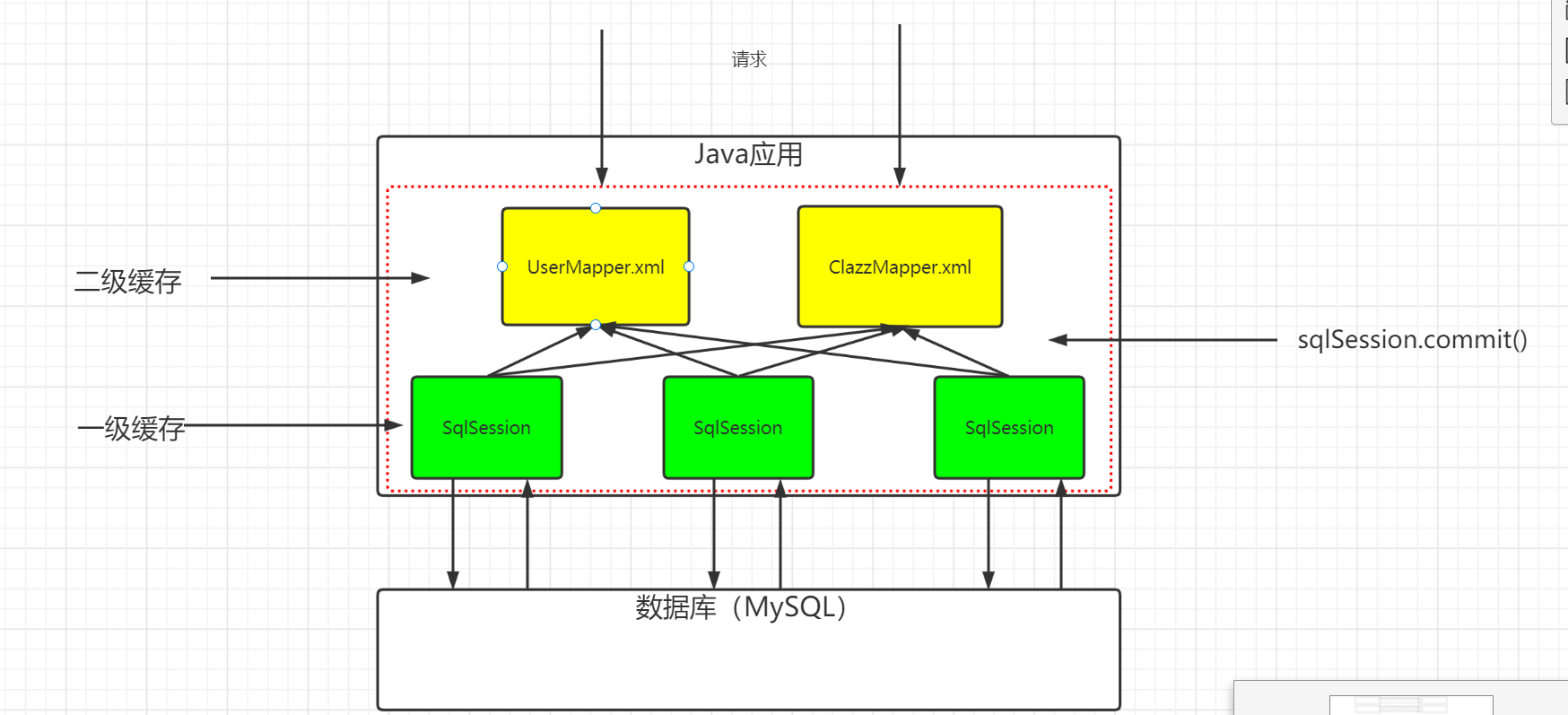
一级缓存是一个以SqlSession管理的缓存(SqlSession级别)。缓存的内容存储在SqlSession中管理。
配置:一级缓存默认是开启的,并且没有提供开关给用户关闭(不可以关闭)。
java一级缓存什么时候失效呢? // SqlSession关闭的时候 // SqlSession调用增删改的时候,会清空当前SqlSession缓存 // SqlSession调用commit方法
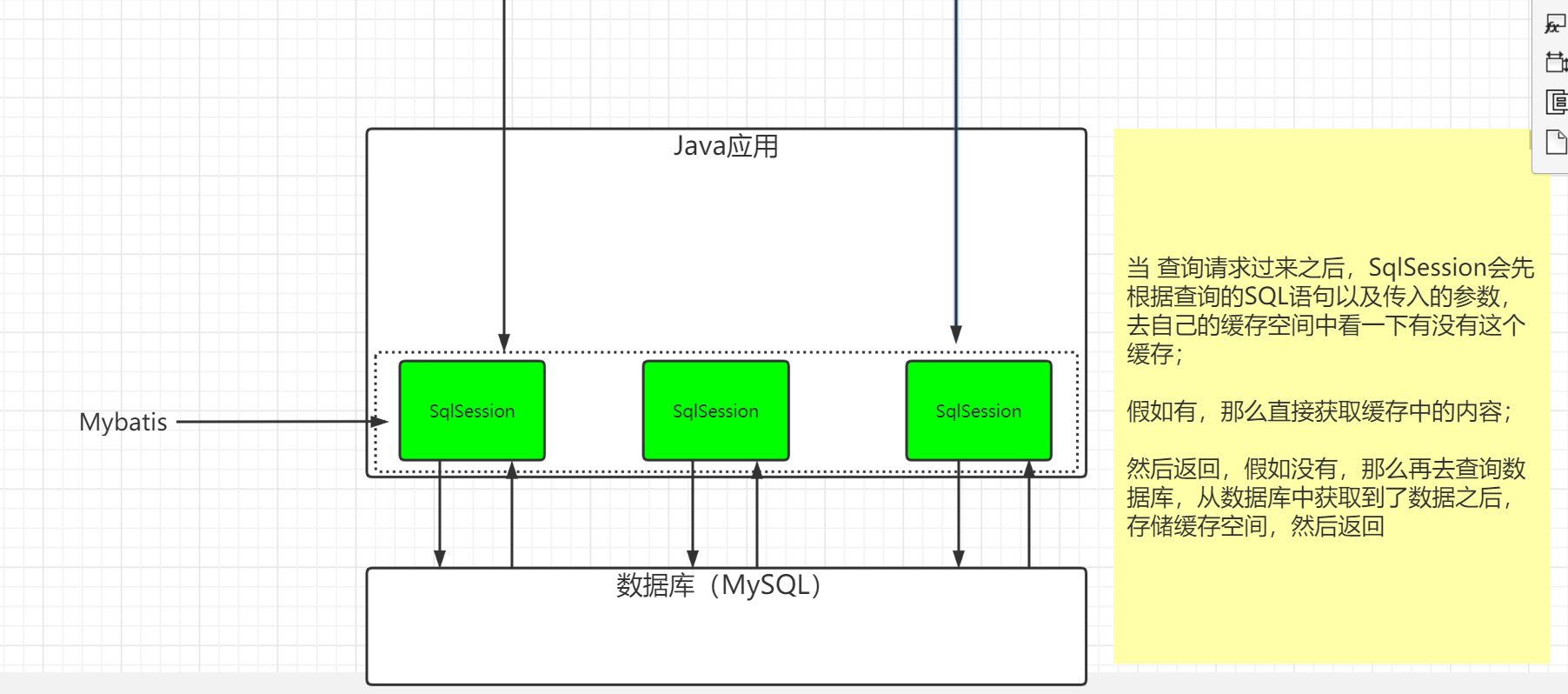
测试
同一个SqlSession 获取的同一个Mapper: 走缓存
同一个SQLSession获取不同的mapper: 走缓存
不同SQLSession获取不同的mapper: 不走缓存
java@Test public void mytest1() { //使用同一个sqlSession的同一个Mapper可以使用到一级缓存 User user1 = userMapper.selectByPrimaryKey(1);//生成缓存 User user2 = userMapper.selectByPrimaryKey(1);//使用缓存 User user3 = userMapper.selectByPrimaryKey(1);//使用缓存 User user4 = userMapper.selectByPrimaryKey(1);//使用缓存 User user5 = userMapper.selectByPrimaryKey(1);//使用缓存 } @Test public void mytest2() { //使用同一个sqlSession的不同Mapper可以使用到一级缓存 UserMapper userMapper1 = sqlSession.getMapper(UserMapper.class); UserMapper userMapper2 = sqlSession.getMapper(UserMapper.class); User user1 = userMapper1.selectByPrimaryKey(1);//生成缓存 User user2 = userMapper1.selectByPrimaryKey(1);//使用缓存 User user3 = userMapper2.selectByPrimaryKey(1);//使用缓存 User user4 = userMapper2.selectByPrimaryKey(1);//使用缓存 } @Test public void mytest3() { //如果sqlSession发生变化,使用不到一级缓存 SqlSession sqlSession1 = sqlSessionFactory.openSession(); SqlSession sqlSession2 = sqlSessionFactory.openSession(); UserMapper userMapper1 = sqlSession1.getMapper(UserMapper.class); UserMapper userMapper2 = sqlSession2.getMapper(UserMapper.class); User user1 = userMapper1.selectByPrimaryKey(1);//生成缓存 User user2 = userMapper1.selectByPrimaryKey(1);//使用缓存 User user3 = userMapper2.selectByPrimaryKey(1);//生成缓存 User user4 = userMapper2.selectByPrimaryKey(1);//使用缓存 } @Test public void mytest4() { //使用同一个sqlSession的同一个Mapper可以使用到一级缓存 User user1 = userMapper.selectByPrimaryKey(1);//生成缓存 User user2 = userMapper.selectByPrimaryKey(1);//使用缓存 User user3 = userMapper.selectByPrimaryKey(1);//使用缓存 sqlSession.commit(); //缓存失效 User user4 = userMapper.selectByPrimaryKey(1);//生成缓存 User user5 = userMapper.selectByPrimaryKey(1);//使用缓存 }
12.2 二级缓存
二级缓存是一个NameSpace级别(mapper.xml)的缓存,每一个NameSpace都有自己的单独的缓存空间。(要通过两级配置开启)
配置1:总开关
xml<!-- 二级缓存开关配置 --> <setting name="cacheEnabled" value="true"/>配置2: 局部开关
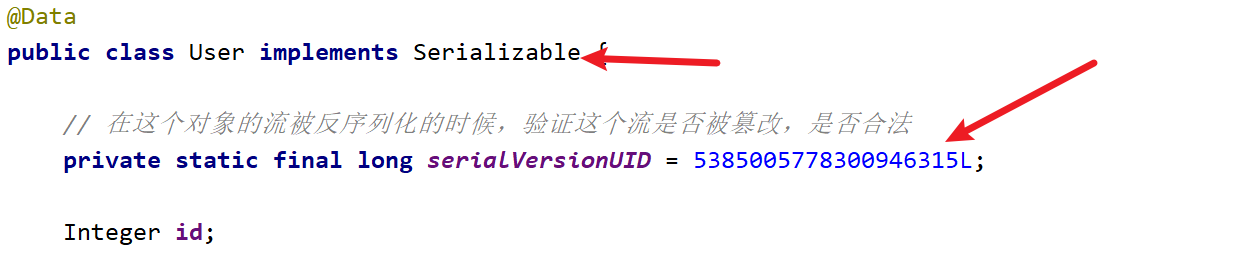
需要对二级缓存的缓存的所有相关对象实现序列化接口
开启自动生成序列化id
实现序列化接口,生成序列化id
java// 1, 二级缓存是 namespace级别/Mapper级别 的缓存 // 2, 多个SqlSession可以共用二级缓存(同一个Mapper) // 3, 在关闭sqlsession后(close); 才会把该sqlsession一级缓存中的数据添加到对应namespace的二级缓存中。 // 4, 讲解时不要简单说成“先查二级缓存再查一级缓存”。 // 对学生来说,更准确的理解是:当前SqlSession主要受一级缓存影响; // 当SqlSession关闭后,数据才有机会进入对应namespace的二级缓存,供其他SqlSession复用。
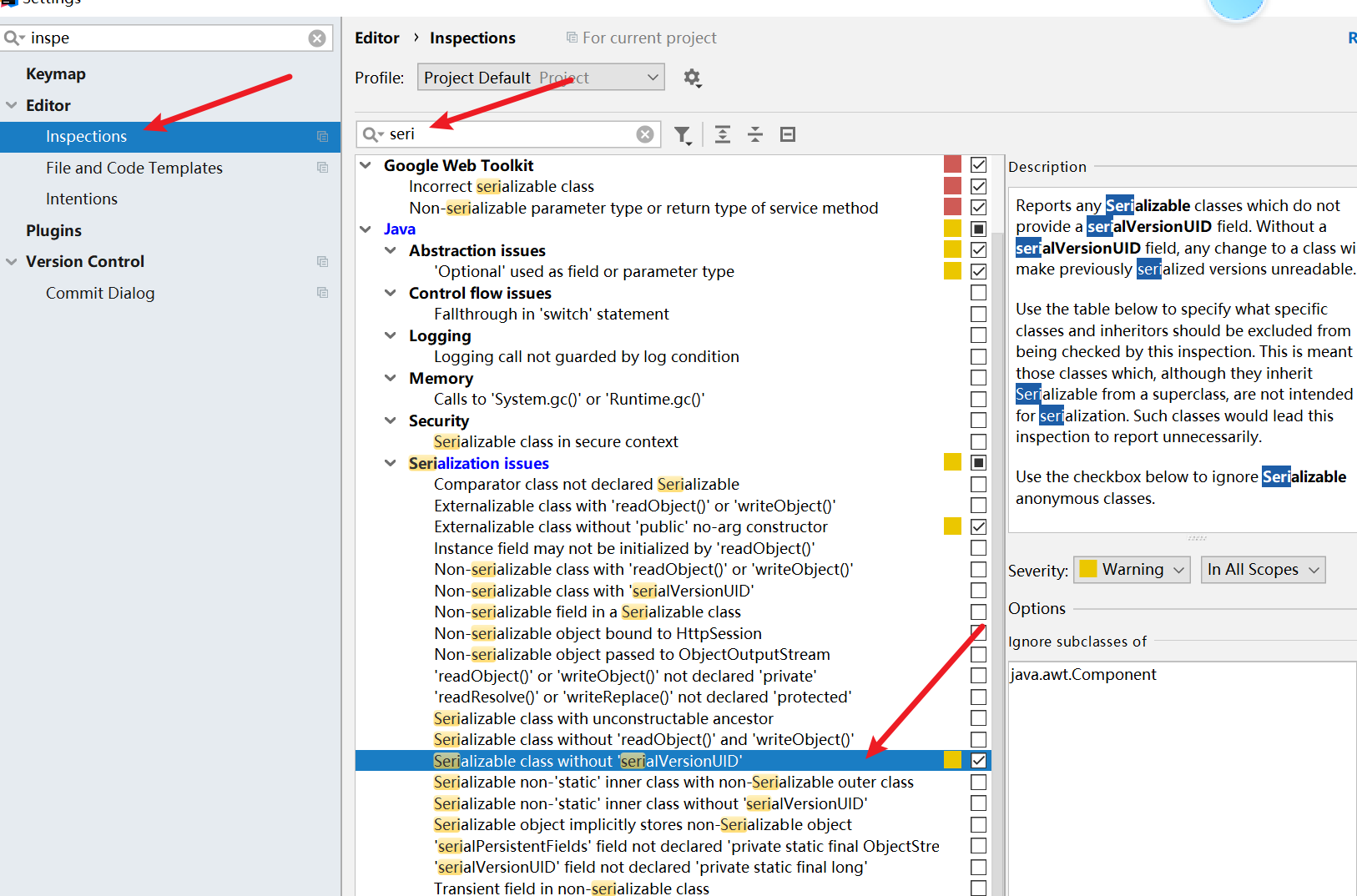
测试
测试
java@Test public void mytest3() { SqlSession sqlSession1 = sqlSessionFactory.openSession(); SqlSession sqlSession2 = sqlSessionFactory.openSession(); SqlSession sqlSession3 = sqlSessionFactory.openSession(); SqlSession sqlSession4 = sqlSessionFactory.openSession(); UserMapper userMapper1 = sqlSession1.getMapper(UserMapper.class); UserMapper userMapper2 = sqlSession2.getMapper(UserMapper.class); UserMapper userMapper3 = sqlSession3.getMapper(UserMapper.class); UserMapper userMapper4 = sqlSession4.getMapper(UserMapper.class); User user1 = userMapper1.selectByPrimaryKey(1); User user2 = userMapper2.selectByPrimaryKey(1); User user3 = userMapper3.selectByPrimaryKey(1); User user4 = userMapper4.selectByPrimaryKey(1); //这个案例没有使用到二级缓存 } @Test public void mytest4() { SqlSession sqlSession1 = sqlSessionFactory.openSession(); SqlSession sqlSession2 = sqlSessionFactory.openSession(); SqlSession sqlSession3 = sqlSessionFactory.openSession(); SqlSession sqlSession4 = sqlSessionFactory.openSession(); UserMapper userMapper1 = sqlSession1.getMapper(UserMapper.class); UserMapper userMapper2 = sqlSession2.getMapper(UserMapper.class); UserMapper userMapper3 = sqlSession3.getMapper(UserMapper.class); UserMapper userMapper4 = sqlSession4.getMapper(UserMapper.class); User user1 = userMapper1.selectByPrimaryKey(1); sqlSession1.close(); //将数据放入二级缓存 User user2 = userMapper2.selectByPrimaryKey(1); User user3 = userMapper3.selectByPrimaryKey(1); User user4 = userMapper4.selectByPrimaryKey(1); User user5 = userMapper4.selectByPrimaryKey(1); //这个案例有使用到二级缓存 cache hit ratio }二级缓存有没有用呢?
- 其实有一定的作用,但是也有一定的缺陷
- 确实能够提高Mybatis的性能
- 不能完美的解决脏数据的问题
- 二级缓存空间对于用户来说是完全透明的,我们用户不能够直接的去操作它,也不能够让用户指定去查询数据库还是查询缓存,所以其实使用起来不太方便
在以后的工作中,有一些需要使用缓存的场景,那么这个时候我们不会考虑使用Mybatis给我们提供的缓存,取而代之的是使用我们的NoSQL数据库(Redis)。
13. 补充
这一节用于收纳开发中高频会碰到、但不一定放在第一轮主线里展开讲授的补充知识点。
13.1 Lombok
Lombok 可以在编译期帮助生成 getter、setter、toString、equals、hashCode 等方法。
优点:减少样板代码,尤其适合实体类、VO、DTO 这类字段较多的场景。
常见注解:
@Data@Getter@Setter@NoArgsConstructor@AllArgsConstructor
使用建议:
- 团队里如果用了 Lombok,最好统一风格
- 知道每个注解到底帮你生成了什么,不要把它当成“黑盒”
- 排查问题时,记得意识到这些方法虽然代码里没写,但编译后是真实存在的
13.2 XML 中的转义字符
在 MyBatis 的 XML 映射文件里,如果直接写比较运算符,容易和 XML 标签语法冲突,所以需要特别注意转义写法。
常见转义字符:
> -> >
< -> <
>= -> >=
<= -> <=例如:
<if test="price != null">
and price >= #{price}
</if>补充说明:
- 在 SQL 标签体中出现
>、<、>=、<=时,优先使用转义字符 - 在
test属性里的 OGNL 表达式中,很多时候也可以直接写逻辑判断,但要注意可读性和团队风格统一 - 如果 SQL 片段比较复杂,也可以使用
CDATA来减少转义干扰
CDATA 示例:
<select id="selectByPrice" resultType="product">
    select * from product
    where 1 = 1
    <![CDATA[
        and price >= #{price}
    ]]>
</select>
13.3 MybatisCodeHelperPro
MybatisCodeHelperPro是一个常见的 MyBatis 开发辅助插件,适合在 XML 映射较多的项目里提升开发效率。
它主要能帮你做这些事:
- 在 mapper 接口和 mapper.xml 之间快速跳转
- 辅助生成常见标签
- 提供一定的代码提示和映射关联能力
使用建议:
- 它适合提升开发效率,但不是理解 MyBatis 原理的前提
- 先把
namespace、id、参数映射、结果映射这些基础关系吃透,再用插件会更顺手